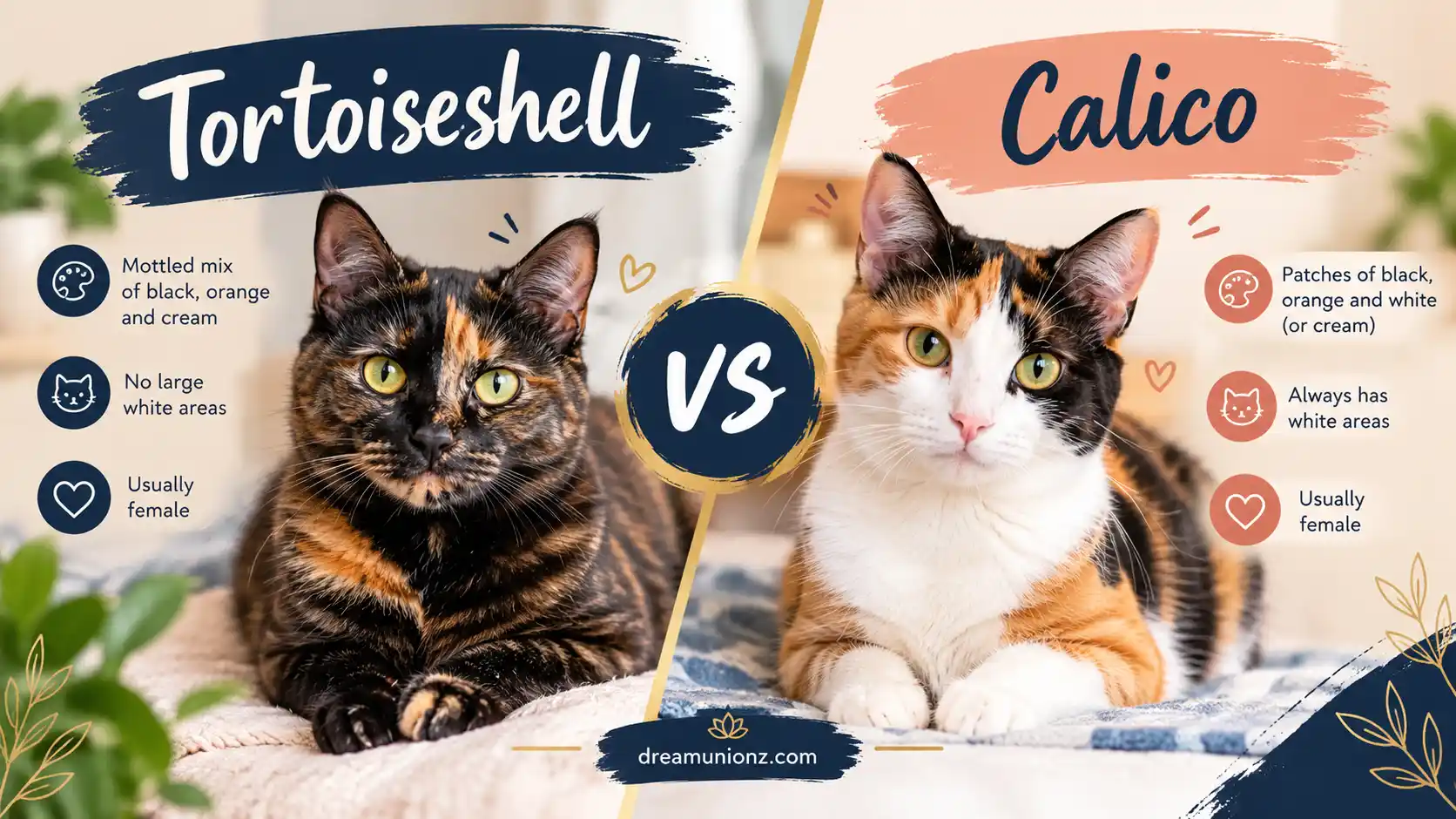
The difference is white fur. Calicos are mostly white with distinct orange and black patches, while tortoiseshells have interwoven orange and black with little or no white.
Tortoiseshell vs Calico at a Glance
Tortoiseshell (Tortie)
White fur: little to none
Pattern: brindled, interwoven
Colors: orange and black blended
Key gene: color genes, no white-spotting
Nickname: tortie
Calico
White fur: significant patches
Pattern: distinct separate blocks
Colors: white, orange, black
Key gene: color genes plus white-spotting
Nickname: calico
What Is a Tortoiseshell Cat?
A tortoiseshell, or tortie, is a cat whose orange and black fur is woven together in a brindled, marbled blend. The name comes from tortoiseshell material, which has the same mottled mix of dark and amber tones.
True torties have little or no white. Some have split faces, one side dark and one side orange. Others are mostly dark with just flecks of orange scattered through.
What Is a Calico Cat?
A calico is mostly white with large, crisp patches of orange and black. The white breaks the colors into clearly separated blocks, which is why calicos look so different from torties.
A popular rule of thumb says that when about 20 percent or more of the coat is white, the cat reads as a calico. The more white there is, the cleaner the color blocks look.
The One-Gene Difference
Genetically, the two patterns are almost identical. The only real difference is the white-spotting gene. Calicos carry it, torties do not.
Without the white-spotting gene, orange and black stay mingled together (tortoiseshell). With it, white fur pushes the colors apart into separate patches (calico). One gene decides the whole look.
Why Are Almost All of Them Female?
Both patterns are 99.9 percent female. The genes for black and orange fur live on the X chromosome, and females have two X chromosomes, so they can display both colors at once.
Males have one X and one Y, so they normally show only one color. A male calico or tortie occurs about 1 in 3,000, usually from an extra X chromosome (XXY), and is almost always sterile.
The X-Inactivation Story
Here is the beautiful part. Early in a female kitten’s development, one of her two X chromosomes randomly switches off in each cell. This is called X-inactivation.
In one cell, the X carrying the orange gene shuts down, so that cell’s descendants make black fur. In a neighboring cell, the black-carrying X shuts down, producing orange fur. This cell-by-cell lottery creates the mosaic coat.
No two torties or calicos are ever alike, because the switch-off pattern is random in every kitten. Each coat is literally one of a kind.
What About Male Calicos?
Male calicos are among the rarest cats in the world. Most are XXY, a condition similar to Klinefelter syndrome in humans. The extra X gives them the genetic toolkit for both colors.
Some male calicos are chimeras, formed when two embryos fuse in the womb. These males can have normal health and even normal fertility, unlike XXY males.
If you ever meet a male calico, you are looking at roughly a 1-in-3,000 event. Breeders and vets get genuinely excited about them.
Patterns, Not Breeds
This surprises many people: neither is a breed. Tortoiseshell and calico are coat patterns that appear across dozens of breeds, from Persians and Maine Coons to ordinary domestic shorthairs.
A cat’s breed comes from its pedigree, never from its color. Two calicos can be completely different breeds wearing the same pattern.
Dilute Versions: Pastel Twins
Both patterns have dilute versions in softer colors. A dilute tortie shows blue-gray and cream brindled together instead of black and orange. A dilute calico shows the same pastel shades in distinct patches on white.
The white rule still applies: lots of white means dilute calico, little or no white means dilute tortie.
Caliby and Torbie: The Striped Cousins
The tricolor family has two more members. A caliby is a calico with tabby stripes inside its patches. A torbie is a tortie with tabby striping overlaid on the brindle.
Same identification trick works: white base means caliby, no white base means torbie.
Personality Myths: Tortitude and Sass
Cat lovers swear torties have “tortitude”, a famously feisty, strong-willed streak. Calicos get a similar reputation for being sweet but sassy.
The science is thin. A 2016 owner survey found slightly higher feistiness reported in tricolor cats, but individual personality varies far more than any pattern predicts. Treat the myths as fun, not fact.
How to Identify Your Cat
Step 1: look at the amount of white. Lots of white means calico; almost none means tortoiseshell.
Step 2: check the pattern style. Clean separate blocks mean calico; blended brindle means tortie.
Step 3: note the shade. Vivid orange and black are standard; soft gray and cream are dilute versions of the same pattern.
Step 4: look for stripes. Stripes inside the patches point to caliby or torbie instead.
People Also Ask
What is the difference between a tortoiseshell and a calico cat?
White fur. Calicos are predominantly white with distinct orange and black patches. Tortoiseshells show the same colors brindled together with little or no white.
Are tortoiseshell cats rare?
No. Tortoiseshell cats are fairly common. What is rare is a male tortoiseshell, occurring about 1 in 3,000, since the pattern is linked to female genetics.
Can a tortoiseshell cat be male?
Extremely rarely. About 1 in 3,000 torties is male, usually carrying an extra X chromosome (XXY). These males are almost always sterile.
Is a calico cat a breed?
No. Calico is a coat pattern, not a breed. It appears in many breeds, including Persians, Maine Coons, and American Shorthairs, plus countless mixed-breed cats.
Do tortoiseshell cats have a different personality?
There is no solid proof. Owners report “tortitude,” a feisty streak, and one survey found modestly higher feistiness, but individual variation dominates. It is mostly folklore.
What is a dilute tortoiseshell?
A tortoiseshell with softened colors: blue-gray and cream instead of black and orange. The brindled pattern is the same, just in pastel shades.
What is the difference between a calico and a tabby?
Pattern type. Calico refers to the white, orange, and black patchwork. Tabby refers to striped markings. A cat can be both, called a caliby.
Are calico cats always female?
Almost always. About 99.9 percent of calicos are female for the same X-chromosome reasons as torties. Male calicos are about 1 in 3,000 and usually sterile.
Which breeds can be tortoiseshell?
Many. Persians, Maine Coons, British Shorthairs, Japanese Bobtails, Cornish Rex, and domestic shorthairs and longhairs all commonly produce torties.
Do calico and tortoiseshell cats get along with other pets?
Pattern does not decide temperament. Socialization, age, and individual personality matter far more than coat color for how a cat handles other pets.
Can a calico cat have kittens of the same pattern?
Sometimes. A calico mother can pass the pattern to her daughters, but the exact patch layout is random every time. No two calico kittens look identical, even as littermates.
Are tortoiseshell cats hypoallergenic?
No. Coat pattern has nothing to do with allergens. No cat is truly hypoallergenic, though some individuals produce less of the Fel d 1 protein that triggers allergies.
What is a patched tabby?
A torbie, the tortoiseshell version of a tabby. It combines the brindled orange-and-black base with visible striped markings for a complex, layered look.
Conclusion
Tortoiseshell vs calico is decided by one thing: white fur. Remember that rule and you will never mix them up again.
Whichever pattern your cat wears, the genetics behind it are genuinely fascinating. Look up the full tortoiseshell story sometime; the X-chromosome science is worth the read.

I am a creative mind driven by research and innovation.
I develop compelling content that informs and inspires audiences.
I publish my work on dreamunionz.com where ideas come to life.