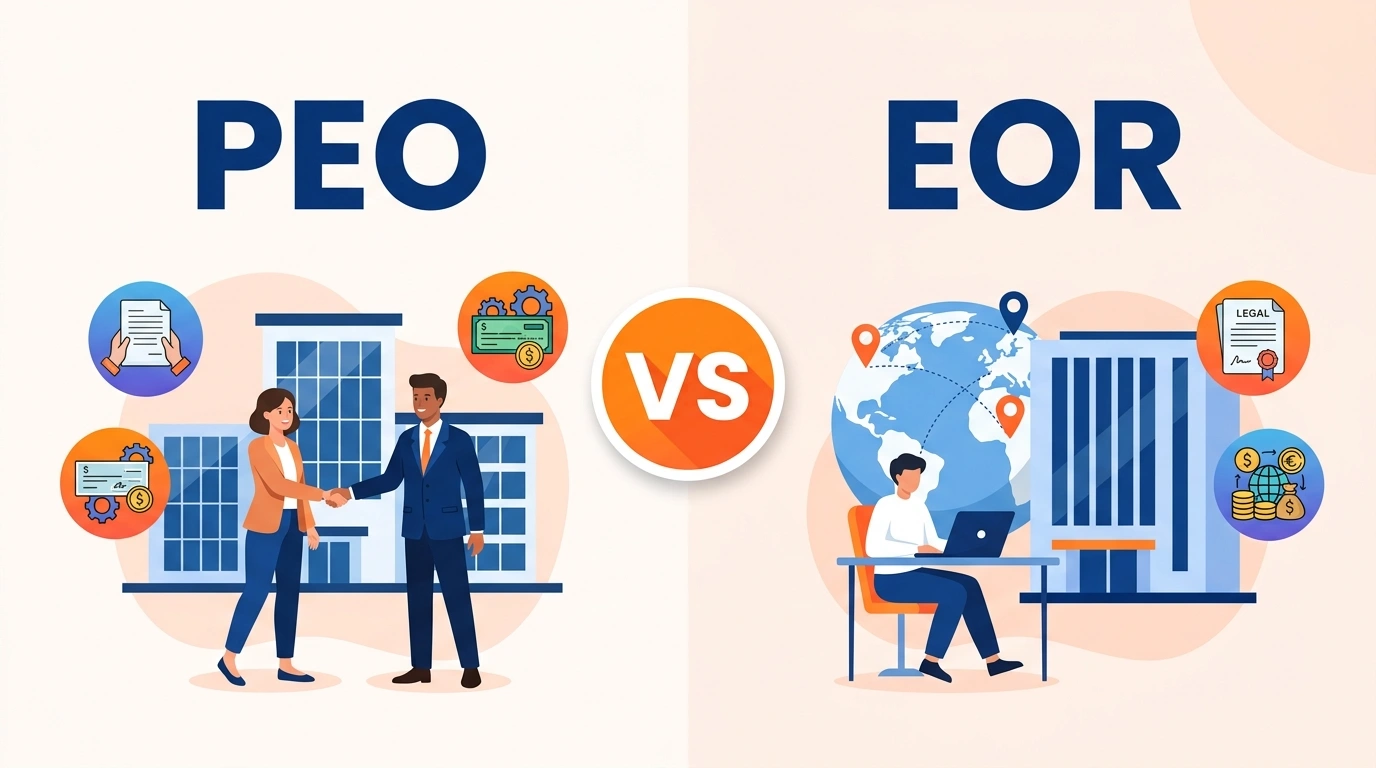
PEO (Professional Employer Organization) is a co-employment HR partner. EOR (Employer of Record) is the legal employer of your workers.
The core difference is simple: with an EOR, you do not need a legal entity in the country where you hire. With a PEO, you must already have one. Get this wrong and you could face costly compliance mistakes or waste months on setup you never needed.
Let us break down what each model does, how they differ, and which one fits your situation.
What Is a PEO?
A Professional Employer Organization is a company that partners with your business to handle HR tasks under a legal arrangement called co-employment.
In this model, the PEO shares specific employer responsibilities with you. It manages payroll processing, administers employee benefits, and helps with localized compliance. But your company remains the legal employer on paper.
Because liability is shared, you must already own a registered legal entity in the jurisdiction where your employees work. A PEO cannot hire people for you in a country where you do not legally exist.
Many PEOs go beyond payroll. They often offer recruitment support, onboarding and offboarding, performance management, training, and risk management. For a growing domestic company, a PEO can feel like an instant HR department.
One catch: PEOs often require a minimum headcount, commonly around 5 to 10 employees, before they will take you on.
What Is an EOR?
An Employer of Record is a third-party organization that legally employs workers on your behalf. The EOR becomes the sole legal employer on paper and absorbs 100 percent of employment law compliance risk.
You still manage the day-to-day work. Your team reports to you, follows your processes, and builds your product. The EOR handles everything legal and administrative behind the scenes.
That includes payroll and tax compliance, benefits administration, employment contracts, local labor law compliance, and termination procedures.
Here is a simple example. You run a software company in the US and want to hire a developer in the Philippines. You have no Philippine entity. An EOR legally hires that developer for you, and you manage their work directly. You can be up and running in weeks instead of months.
EORs are built for borderless hiring and often scale down to a single employee. There is usually no minimum headcount.
PEO vs EOR: Key Differences
Legal employer status: an EOR is the sole legal employer. A PEO is a co-employer that shares liability with you.
Entity required: EOR needs no local entity. PEO requires you to own a registered entity where staff work.
Compliance liability: the EOR absorbs 100 percent of employment compliance risk. With a PEO, the risk is shared, and you stay liable for corporate compliance.
Geography: EORs work internationally and domestically. PEOs work primarily domestically, in countries where you already operate.
Primary use case: EOR is for rapid international expansion and hiring abroad. PEO is for streamlining HR administration for an existing local workforce.
Minimum headcount: EORs often accept a single employee. PEOs often require 5 to 10 or more.
Cost structure: EORs typically charge a flat monthly rate per employee. PEOs typically charge a percentage of payroll or a per-employee fee.
When to Choose a PEO
Choose a PEO when you already have a legal entity and want to outsource HR heavy lifting. This is the classic domestic growth story.
A PEO is ideal if your company is growing fast but has no real HR infrastructure yet. It is also a strong fit when you want competitive benefits packages, since PEOs pool employees across clients to negotiate better rates.
It works well for employers who want to reduce administrative tasks while keeping full legal control of their workforce. If your team all sits in one country where you are already registered, a PEO is usually the simpler and cheaper path.
When to Choose an EOR
Choose an EOR when you want to hire in a country where you have no entity. This is the entire reason the EOR model exists.
An EOR is ideal for testing new international markets quickly and cheaply. Instead of spending months and thousands of dollars setting up a foreign subsidiary, you can hire your first employee in weeks.
It is also the right call for remote workers across multiple jurisdictions. If you have one person in Spain, one in Brazil, and one in India, an EOR keeps every hire compliant under local law without you becoming a legal expert in three countries.
Finally, choose an EOR when compliance risk keeps you up at night. Misclassifying workers or botching foreign payroll can trigger fines and lawsuits. The EOR takes that risk onto its own books.
PEO vs EOR Cost Comparison
PEOs are generally more cost-effective in local markets. Fees are usually a percentage of payroll or a modest per-employee monthly fee, and the service replaces work your HR team would otherwise do.
EORs are typically more expensive per employee, often a flat monthly rate that reflects their role as the full legal employer with regulatory obligations in each country.
But the sticker price is misleading. An EOR eliminates the cost of setting up and maintaining a foreign entity, which can run into tens of thousands of dollars per country. For international hiring, the EOR is often cheaper overall.
The honest way to compare: add up entity setup, legal fees, ongoing compliance, and admin time for each country. Then compare that total against the EOR’s per-employee fee.
Common Mistakes to Avoid
Using the terms interchangeably: PEO and EOR are not synonyms. One is a co-employment partner, the other is the legal employer. Using the wrong one can leave you non-compliant.
Hiring abroad with a PEO and no entity: a PEO cannot legally employ workers where you have no registered entity. This is the most expensive mistake on this list.
Comparing only the monthly fee: always include entity setup, legal costs, and compliance risk in your math before declaring one model cheaper.
Ignoring termination rules: firing someone in France or Brazil works nothing like firing someone in Texas. Make sure your provider actually handles local termination law, not just payroll.
Skipping the contract review: read exactly who holds liability for tax filings, benefits, and disputes. The fine print is where co-employment and full employment actually differ.
People Also Ask
What is the main difference between PEO and EOR?
The main difference is legal employer status. An EOR is the sole legal employer of your workers. A PEO is a co-employer that shares responsibilities while your company stays the legal employer.
Do I need a legal entity to use an EOR?
No. That is the biggest advantage of an EOR. You can hire in a foreign country without setting up a local entity.
Do I need a legal entity to use a PEO?
Yes. A PEO requires you to already own a registered entity in the jurisdiction where your employees work, because the co-employment model shares liability with you.
Is an EOR more expensive than a PEO?
Per employee, usually yes. But an EOR removes the cost of setting up and maintaining foreign entities, so for international hiring it is often cheaper overall.
Can a PEO hire international employees?
Only in countries where you already have a registered entity. A PEO cannot hire workers in a country where your company does not legally exist. For that, you need an EOR.
Who manages the employee day to day with an EOR?
You do. The EOR handles contracts, payroll, taxes, benefits, and compliance. Your company directs the daily work, goals, and management.
Can I switch from a PEO to an EOR later?
Yes. Many companies start with a PEO domestically, then use an EOR when they expand abroad. Some providers even offer both models, which makes the transition smoother.
Conclusion
PEO vs EOR comes down to one question: do you need a legal employer or an HR partner? If you are hiring abroad without an entity, the EOR is your answer. If you already operate locally and want HR off your plate, the PEO fits.
Get the legal structure right from the start, compare total costs instead of just monthly fees, and read the fine print on liability. Do that, and whichever model you choose will keep your hiring fast, legal, and fully compliant.

I am a creative mind driven by research and innovation.
I develop compelling content that informs and inspires audiences.
I publish my work on dreamunionz.com where ideas come to life.