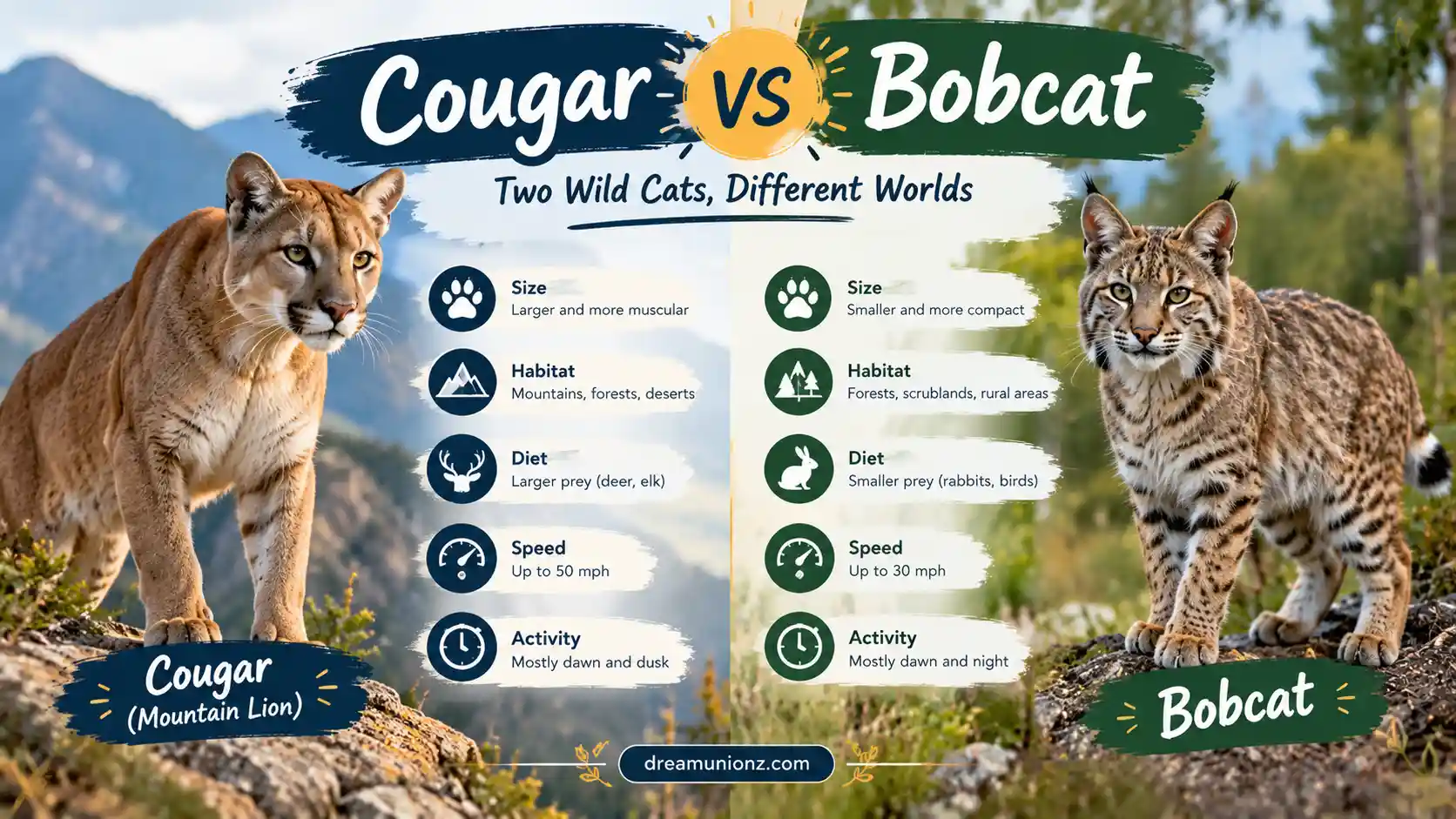
A cougar is much larger than a bobcat, with a long tail and solid tawny coat, while bobcats are smaller with spotted coats and stubby tails. Size and tail are the fastest ways to tell them apart.
Cougar vs Bobcat at a Glance
Cougar
Weight: 90 to 220 lbs
Length: 7 to 9 feet
Tail: long, 2.5 to 3 feet
Coat: solid tawny, no spots
Also called: mountain lion, puma
Bobcat
Weight: 15 to 40 lbs
Length: about 3 feet
Tail: short bob, under 10 inches
Coat: spotted, tufted ears
Also called: wildcat, bay lynx
Size: The Biggest Giveaway
Size settles most debates. An adult cougar weighs 90 to 220 pounds and stretches 7 to 9 feet from nose to tail tip. A bobcat weighs just 15 to 40 pounds and measures about 3 feet long.
Think of it this way: a cougar is roughly the size of an adult human lying down, while a bobcat is closer to a large house cat. If the cat you saw looked enormous, it was almost certainly a cougar. Trail camera photos often exaggerate size, so compare the animal against nearby objects like fence posts before deciding.
Tail: The Fastest Field Mark
When you only get a glimpse, check the tail. Cougars have a long, thick tail measuring 2.5 to 3 feet, often with a dark tip. It is about a third of their total body length.
Bobcats have a short, stubby “bobbed” tail under 10 inches long, which is how they got their name. Long tail means cougar. Stubby tail means bobcat. It is that simple.
Coat and Facial Features
Cougars wear a solid coat. Adults are uniformly tawny, reddish-brown, or grayish, with no spots. Their muzzle is whitish with dark markings around the eyes.
Bobcats wear patterns. Their coats are spotted or mottled, with tufted ears tipped in black and distinctive facial ruffs framing the cheeks. Those ear tufts are a dead giveaway no cougar has.
Habitat and Range
Bobcats live across North America, from forests to swamps to suburban edges. They are adaptable and tolerate human presence fairly well.
Cougars range much wider, from Canada to South America, favoring mountains, forests, and remote terrain. They are more reclusive and avoid people whenever possible, roaming huge territories.
Hunting and Diet
Both are solitary ambush predators, most active at dawn and dusk. But their menus reflect their size. Bobcats hunt rabbits, squirrels, and birds, while cougars take down deer, elk, and other large prey.
A cougar’s power lets it kill animals many times its size. A bobcat, despite its fierce reputation, sticks to small game it can overpower safely.
Behavior Around Humans
Bobcat encounters are low-risk. Bobcat attacks on people are virtually unknown. They usually flee long before you notice them.
Cougar encounters demand respect. Attacks are extremely rare, but cougars are large predators. If you see one, make yourself look big, maintain eye contact, and never run. Running can trigger a chase response.
Sounds and Communication
Cougars are famously vocal. They cannot roar, but they produce eerie screams, chirps, and purrs. A cougar’s scream in the night is unforgettable once you have heard it.
Bobcats are quieter. They meow, hiss, growl, and purr much like a house cat, just deeper. Their sounds rarely carry far, matching their stealthy lifestyle.
Lifespan and Reproduction
In the wild, cougars live about 8 to 13 years, while bobcats average 7 to 10 years. Both live longer in captivity, where food is steady and injuries get treated.
Cougar mothers raise 1 to 6 kittens for up to two years, teaching them to hunt. Bobcat mothers raise 1 to 7 kittens but the young become independent sooner, often within a year.
Kittens: Why Babies Look Alike
Here is where confusion starts. Cougar kittens are born spotted, with blue eyes and ringed tails, looking nothing like their plain-coated parents. The spots fade by about 6 months of age.
Bobcat kittens are born spotted too and keep their markings for life. So if you see a spotted kitten with a long tail, it is a young cougar. Spotted kitten with a stubby tail means bobcat.
Conservation Status
Both species are doing okay overall. Neither the cougar nor the bobcat is endangered at the species level, and both have stable or growing populations in many areas.
The exception is the Florida panther, a cougar subspecies with only a few hundred individuals left. It is federally protected and remains one of North America’s most endangered mammals.
Common Identification Mistakes
Confusing a large bobcat with a small cougar: even a big bobcat is half the weight of a small cougar. Trust the scale.
Missing the tail: people focus on the body and forget the tail test, which is the single most reliable field mark.
Thinking spots mean young cougar: cougar kittens do have spots, but they fade with age. A spotted adult cat is a bobcat.
Assuming “panther” is a third cat: in North America, “panther” usually means cougar, especially the Florida panther. Same animal, different name.
People Also Ask
Is a bobcat the same as a cougar?
No. They are different species. The bobcat (Lynx rufus) is small with a stubby tail, while the cougar (Puma concolor) is a large predator also called a mountain lion or puma.
Which is bigger, a bobcat or a cougar?
The cougar, by far. Cougars weigh 90 to 220 pounds versus 15 to 40 for bobcats, and measure 7 to 9 feet long versus about 3 feet.
Can a bobcat kill a human?
Virtually never. Bobcat attacks on people are essentially unheard of. They avoid humans and prey on small animals.
Are cougars dangerous to humans?
Rarely, but take them seriously. Attacks are extremely uncommon, but cougars are powerful predators. Make yourself look large, hold eye contact, and never run.
Do bobcats and cougars live in the same areas?
Yes, their ranges overlap across much of North America. Bobcats tolerate suburbs and varied habitat, while cougars prefer wilder, more remote terrain.
What is the difference between a cougar, puma, and mountain lion?
Nothing, they are the same animal. Puma concolor holds the record for the most English names of any mammal, with over 40, including cougar, puma, mountain lion, panther, and catamount.
How can you tell a bobcat track from a cougar track?
Size. Cougar tracks are about 3 to 4 inches across, roughly the size of your palm. Bobcat tracks are about 2 inches, closer to a large house cat’s print.
Do cougars eat bobcats?
Occasionally. Cougars are apex predators and have been known to kill bobcats, though bobcats are not a regular prey item. The two generally avoid each other.
What should you do if you see a bobcat?
Enjoy the moment. Bobcats are shy and will leave on their own. Keep pets indoors, give it space, and never try to feed or approach it.
Are bobcats good climbers like cougars?
Yes, both climb well. Cougars are the stronger climbers, able to leap 15 feet up a tree in a single bound. Bobcats climb readily too, but with less explosive power.
Why do cougars have so many names?
History and geography. Different regions named the same animal independently: Spanish settlers said “puma,” French trappers said “cougar,” and English colonists said “mountain lion.” All stuck.
Conclusion
Cougar vs bobcat comes down to three checks: size, tail, and coat. Huge with a long tail and solid coat means cougar. Small with a stubby tail and spots means bobcat. When in doubt, the tail test almost never lies.
Both are remarkable wild cats worth admiring from a respectful distance. Next time one crosses your trail camera, you will know exactly which cougar or bobcat you are looking at.

I am a detail-oriented writer passionate about digital content creation.
I focus on producing clear, engaging, and reader-friendly articles.
I proudly contribute to dreamunionz.com as a committed content author.