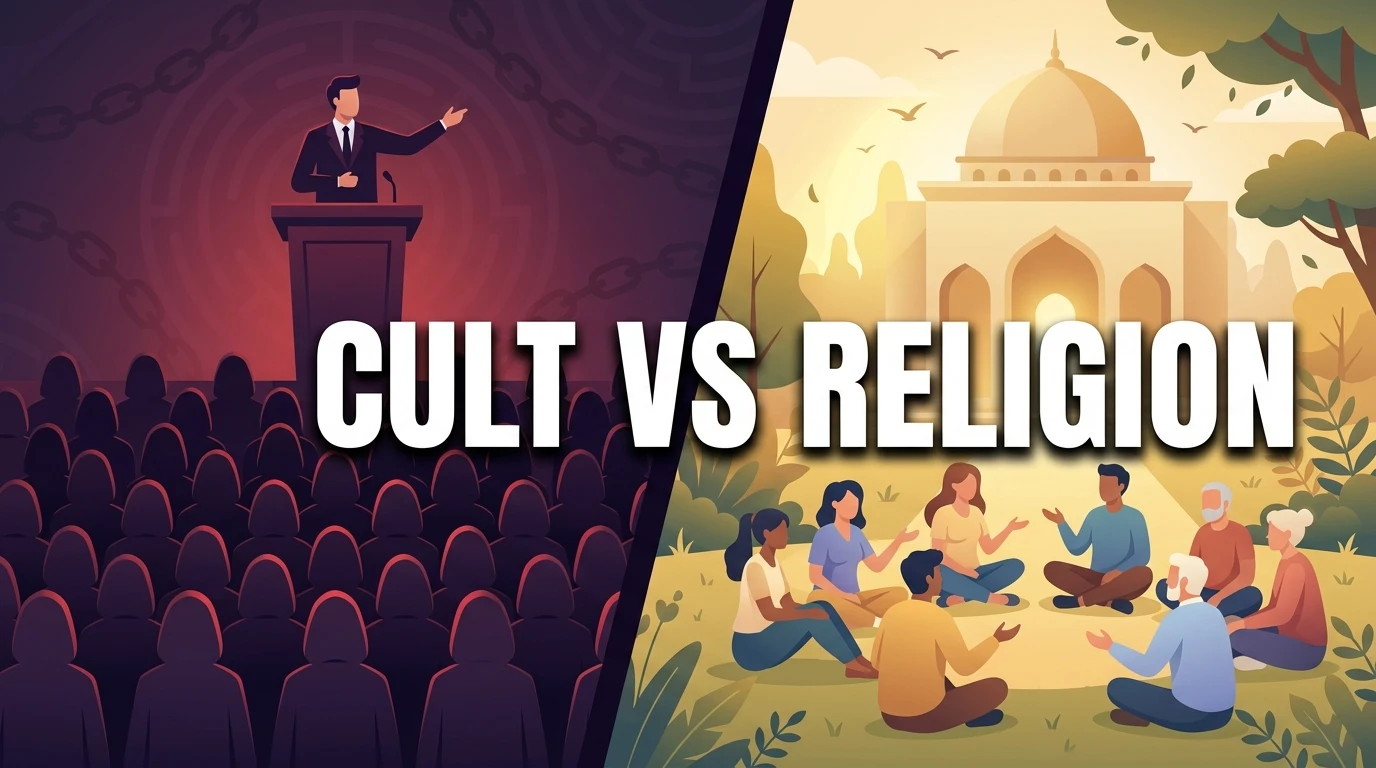
A religion is an established, socially recognized system of faith, built on shared texts, rituals, and traditions. A cult is typically a smaller, newer group centered on a charismatic leader, with strict control over members.
The key difference comes down to control and openness. Religions generally support personal growth within a community. Cults tend to demand obedience, isolate members, and punish questioning. Let us look at both sides carefully and fairly.
What Is a Religion?
A religion is an organized system of beliefs, practices, and moral codes shared by a community of followers. It usually includes sacred texts, rituals, holidays, and traditions passed down through generations.
Religions are integrated into culture. They influence laws, values, art, and social structures. Being a member of a mainstream religion is normally compatible with everyday life: work, family, friendships, and personal freedom all continue.
Most religions have accountable leadership, established institutions, and room for interpretation. Questioning and discussion are generally allowed, even if not always encouraged in every tradition.
What Is a Cult?
A cult is usually a smaller and newer group built around a charismatic leader or an unusual set of teachings. In sociology, cults are classified as new religious movements, distinct from sects, which break away from an existing tradition.
What sets harmful cults apart is control. Common traits include unquestioning devotion to the leader, isolation from family and friends, punishment of doubt and dissent, and pressure to cut ties with outside life.
One honest note: scholars often avoid the word cult because it has become a pejorative label. In academic work, you will usually see the neutral term new religious movement (NRM) instead.
Cult vs Religion: Key Differences
Size and age: religions are typically large and centuries old. Cults are usually small and recently formed.
Leadership: religions have institutions and accountable leaders. Cults revolve around a single charismatic leader whose word is final.
Authority: religions base authority on sacred texts and tradition. Cults base it on the leader’s personal claims.
Control: religions generally allow personal freedom in daily life. Cults often dictate how members think, act, work, and live.
Questioning: religions usually tolerate discussion and doubt. Cults punish dissent and treat questions as betrayal.
Isolation: religions keep members connected to wider society. Cults push members to separate from family and friends.
Leaving: people can generally leave a religion freely. Cults often use guilt, threats, or shunning to stop members from leaving.
Social acceptance: religions are recognized and integrated into culture. Cults are viewed with suspicion by wider society.
Warning Signs of a Cult
Not every small spiritual group is harmful. But experts point to consistent warning signs that separate healthy communities from controlling ones.
Absolute leader: one person claims exclusive truth and cannot be questioned.
Isolation: you are told to cut contact with family, friends, or anyone critical of the group.
Us versus them: the group teaches that outsiders are dangerous or evil and only members have the truth.
Financial pressure: constant demands for money, property, or free labor with little transparency.
Fear-based control: threats of punishment, disaster, or spiritual doom if you disobey or leave.
Information control: outside books, news, and voices are banned or dismissed as lies.
If several of these appear together, that is a serious red flag. Healthy faith communities do not need to trap their members.
How to Evaluate Any Spiritual Group
Whether you are joining a community or worried about someone in one, these practical questions help you judge fairly.
Can members leave freely? a healthy group respects your choice to walk away. A controlling group makes leaving feel impossible.
Are finances transparent? legitimate groups can explain where money goes. Secrecy around funds is a red flag.
Is outside information allowed? healthy communities welcome questions and outside perspectives. Controlling ones ban them.
Does the leader answer to anyone? accountable leadership has checks and balances. Absolute, unchallengeable authority is dangerous.
Are families kept together? good groups strengthen family bonds. Harmful ones try to replace or break them.
How do former members talk about it? listen to people who left. A pattern of similar painful stories is telling.
Trust your instincts too. If something feels wrong, pause and talk to someone outside the group before going deeper.
The Blurry Line Between Them
Here is the uncomfortable truth scholars acknowledge: every major religion started small. Christianity began as a small movement around Jesus. Scholars note that groups like Christian Science and the Nation of Islam began as new movements and grew into recognized denominations.
As groups grow, they tend to bureaucratize: they write down beliefs, build institutions, and create accountability. Some scholars say the difference between a cult and a religion can partly come down to size, age, and social acceptance.
This does not mean the distinction is meaningless. The control test still matters most. A group of any size that isolates, manipulates, and punishes is behaving like a cult, while a small community that respects freedom is not.
The fairest summary: religion is about shared faith, while a cult is about control. Size and history matter less than how members are treated.
People Also Ask
What is the main difference between a cult and a religion?
The main difference is control. A religion is an established, socially accepted faith that allows personal freedom. A cult is a smaller group centered on a charismatic leader that demands obedience and often isolates members.
Can a cult become a religion?
Yes. Sociologists note that as new movements grow, organize, and gain acceptance, they can develop into recognized denominations. Several established groups began as small new movements.
Why do scholars avoid the word cult?
Because it has become a pejorative label used to discredit groups rather than describe them. Academics prefer the neutral term new religious movement (NRM).
What are the warning signs of a cult?
Key signs include an unchallengeable leader, isolation from family and friends, us-versus-them thinking, financial exploitation, punishment of dissent, and blocking outside information.
Is every new spiritual group a cult?
No. Many small spiritual communities are open, ethical, and respectful of members’ freedom. The label depends on behavior, especially control and manipulation, not on size or newness alone.
What is the difference between a sect and a cult?
A sect breaks away from an existing religion to return to its fundamentals. A cult forms around something new, often a charismatic leader or new teachings, without breaking from a parent tradition.
Can you leave a cult safely?
Leaving can be difficult because of emotional, social, and sometimes financial pressure. Support from family, counselors, and exit-support organizations makes it much safer. If you or someone you know needs help, reaching out to a trusted professional is the right first step.
Do cults always have a single leader?
Usually, but not always. Most cults center on a charismatic leader, but some are built around an ideology or system with a small inner circle in charge. The key trait is unquestionable authority, whatever form it takes.
Are all religions free of cult-like behavior?
No group is perfect. Scholars note that even large religions can have subgroups or leaders who act in controlling ways. The difference is that healthy religions have structures for accountability and reform, while cults protect the leader at all costs.
Conclusion
Cult vs religion is not about which beliefs are right. It is about how people are treated. Religions offer shared faith within an open community. Cults demand obedience inside a closed one.
The clearest test is simple: does the group respect your freedom to question, to connect with others, and to leave? If yes, you are looking at a healthy community of belief. If not, no label can make that okay.

I am a professional content writer focused on delivering value through words.
I craft informative and engaging articles across diverse topics.
I actively write for dreamunionz.com to share knowledge and creativity.