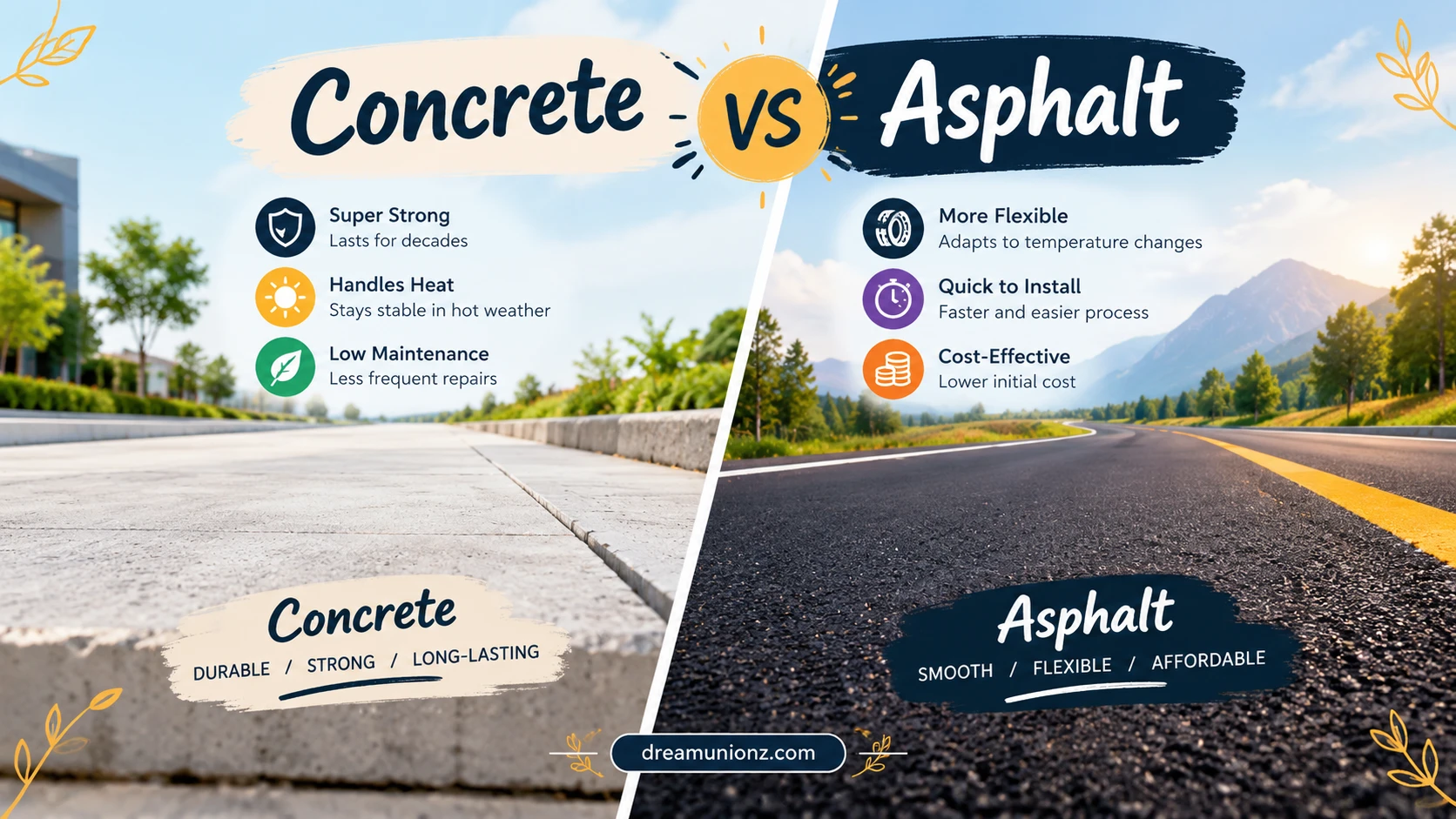
Concrete lasts longer and needs less maintenance, while asphalt costs less upfront and handles freezing winters better. The best choice depends on your climate and budget. Here is the full breakdown.
Concrete vs Asphalt at a Glance
Concrete
Lifespan: 25 to 50 years
Upfront cost: higher
Maintenance: minimal
Best climate: hot regions
Look: customizable finishes
Asphalt
Lifespan: 15 to 30 years
Upfront cost: lower
Maintenance: seal every 2 to 5 years
Best climate: cold regions
Look: classic black
What Is the Main Difference?
The core difference is flexibility. Asphalt is a flexible pavement that bends slightly with ground movement, while concrete is a rigid slab that stays stiff. This single trait drives almost every other difference between them.
Asphalt is made with a tar-like binder holding crushed stone together. Concrete uses cement as its binder. Both are strong, but they age in very different ways.
Cost: Which Is Cheaper?
Asphalt wins upfront. An asphalt driveway typically costs 10 to 30 percent less than concrete to install. Average installations run around $5,200 for asphalt versus $6,400 for concrete.
But the story changes over time. Asphalt needs sealcoating every 2 to 5 years, which adds ongoing cost. Concrete needs little routine care. Over a 30-year span, the total costs end up surprisingly close.
Durability and Lifespan
Concrete lasts longer. A well-built concrete driveway can serve 25 to 50 years, roughly double the 15 to 30 years you get from asphalt.
Concrete also handles heavy loads better, supporting trucks and RVs that would rut soft asphalt. If longevity is your top priority, concrete is the clear winner.
Climate: The Real Deciding Factor
Climate matters more than most people realize. Asphalt excels in cold regions because it flexes through freeze-thaw cycles instead of cracking. Its dark color also absorbs sunlight, melting snow and ice faster.
Concrete excels in hot regions. It never softens in summer heat, while asphalt can get tacky and develop ruts under heavy vehicles on scorching days. But concrete suffers in freezing climates, where deicing salt can cause surface scaling.
Installation and Curing Time
Asphalt is faster. Most asphalt driveways are paved in a day or two and ready for cars within 2 to 3 days.
Concrete demands patience. It needs about 7 days before it can take vehicle traffic, and a full 28 days to reach complete strength. Driving on it early causes cracks that never really heal.
Maintenance and Repairs
Asphalt needs regular attention. Plan on sealcoating every few years plus occasional crack filling. The upside: repairs are cheap, easy, and blend in well.
Concrete needs less routine care but repairs are harder. Patches on concrete are visible and costly, often requiring professional help. When concrete cracks badly, whole sections may need replacement.
Appearance and Curb Appeal
Concrete wins on looks. It can be stamped, stained, tinted, or textured to mimic stone, brick, or tile. The design options are nearly endless.
Asphalt is always black, with essentially no finish options. It looks clean and classic, but it will never be decorative. If curb appeal drives your home’s value, concrete has the edge.
How Each Material Is Made
Understanding the ingredients explains the behavior. Asphalt mixes crushed stone and sand with bitumen, a sticky black petroleum product. It is heated, laid hot, and compacted. Traffic can use it almost immediately.
Concrete mixes crushed stone and sand with cement powder and water. A chemical reaction called hydration hardens it over days and weeks. That slow cure is why concrete is stronger but demands patience.
Which Adds More Home Value?
Concrete usually wins at resale time. Buyers perceive it as premium, especially with decorative finishes. A well-kept concrete driveway can boost curb appeal noticeably.
Asphalt does not hurt value, but it rarely adds any. If you plan to sell within a few years, concrete’s visual upgrade may pay for part of its higher cost.
Which Should You Choose?
Choose asphalt if: you live in a cold climate, want lower upfront cost, need it done fast, or expect to repair easily.
Choose concrete if: you live in a hot climate, want maximum lifespan, prefer low maintenance, or value decorative finishes.
There is no universal winner. The right answer is the one that matches your weather, your budget, and your patience for maintenance.
Common Mistakes to Avoid
Choosing on price alone: the cheapest bid often skips proper base preparation, and both materials fail fast on a bad base.
Ignoring drainage: water pooling destroys asphalt and concrete alike. Grade and drainage matter more than the surface material.
Driving on concrete too early: impatience causes cracks that never heal. Respect the 7-day rule.
Skipping asphalt sealcoating: unsealed asphalt ages twice as fast. The small recurring cost protects the big investment.
What About Roads and Highways?
The driveway logic scales up. Most American roads are asphalt because it is cheaper to lay, faster to repair, and quieter for drivers. When a highway lane needs resurfacing, crews can mill and repave asphalt overnight.
Concrete dominates high-traffic truck routes and airport runways, where its rigidity handles extreme loads for decades. Many interstates use concrete slabs designed to last 30-plus years with minimal closures.
People Also Ask
Is concrete or asphalt better for a driveway?
It depends on climate. Asphalt suits cold regions with freeze-thaw winters, while concrete suits hot regions. Asphalt costs less upfront; concrete lasts longer with less maintenance.
How long does asphalt last compared to concrete?
Asphalt lasts 15 to 30 years; concrete lasts 25 to 50 years. Proper maintenance extends both, but concrete’s lifespan is roughly double.
Why is asphalt cheaper than concrete?
Asphalt uses less expensive materials and installs faster with simpler equipment. Concrete requires more costly materials, forming, and longer curing time.
Does asphalt melt in hot weather?
It does not melt, but it can soften significantly in extreme heat, leading to ruts and indentations from heavy vehicles. Concrete has no such problem.
Can you put concrete over asphalt?
Yes, sometimes. Pouring concrete over a stable asphalt base is a known upgrade method, but the old surface must be sound and well-drained. A contractor should assess it first.
Which is better for the environment?
Both have trade-offs. Asphalt is highly recyclable, with old pavement routinely reused. Concrete’s lighter color reflects heat, reducing the urban heat island effect, but cement production is carbon-intensive.
Does concrete crack more than asphalt?
In cold climates, yes. Concrete’s rigidity makes it vulnerable to freeze-thaw cracking, while flexible asphalt absorbs ground movement. In hot climates the reverse pressure applies.
How often does asphalt need to be sealed?
Every 2 to 5 years, depending on climate and traffic. Regular sealcoating is the single most important maintenance task for an asphalt driveway.
Is concrete slippery when wet?
It can be. Smooth-finished concrete gets slippery, but a broom finish or textured surface provides good traction. Ask your contractor for a non-slip finish.
Which driveway is quieter to drive on?
Asphalt is quieter. Its slightly flexible, textured surface absorbs more tire noise than rigid concrete, which is one reason highways in residential areas often use asphalt.
Can weeds grow through asphalt or concrete?
Yes, through cracks in either. Weeds exploit any opening, but they invade unsealed asphalt cracks more easily. Sealing cracks promptly and using a vegetation barrier at the edges keeps both surfaces clean.
Conclusion
Concrete vs asphalt is really a question of priorities. Choose concrete for longevity, low maintenance, and beauty. Choose asphalt for affordability, speed, and winter performance. Match the material to your climate and you will not go wrong.
Still unsure? Get quotes for both from a local paving contractor. Real concrete numbers for your specific driveway beat any general guide, and a good contractor will tell you honestly which material suits your soil and climate.

I am a creative mind driven by research and innovation.
I develop compelling content that informs and inspires audiences.
I publish my work on dreamunionz.com where ideas come to life.