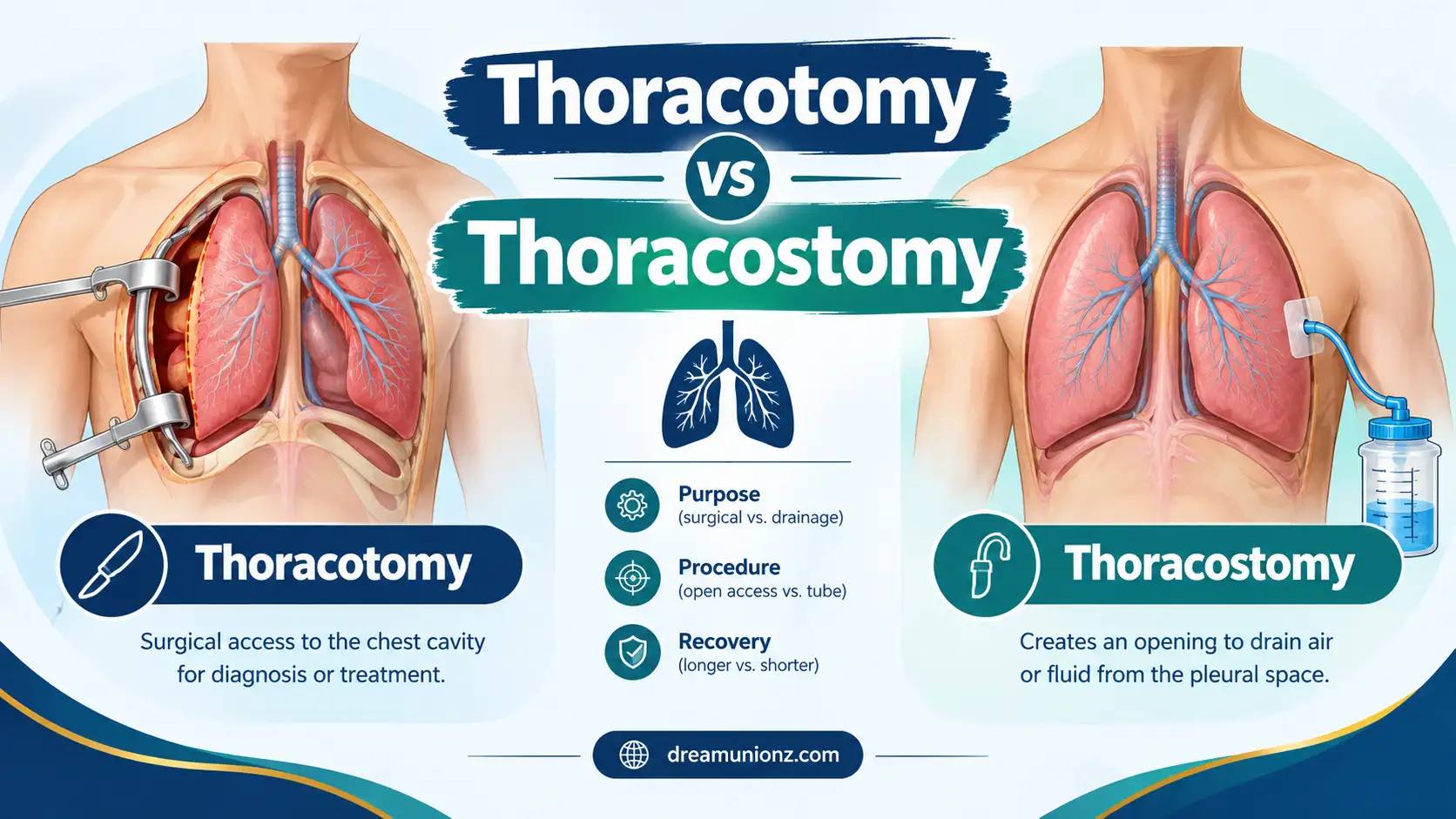
Thoracotomy is surgery that opens the chest so a surgeon can operate on the lungs, heart, or other organs inside. Thoracostomy is a much smaller procedure that creates a drainage opening in the chest wall, usually to place a chest tube.
The names look almost identical, but the procedures are very different. One is major open surgery. The other is a minimally invasive drainage procedure. Mixing them up can cause real confusion, so let us break down each one clearly.
Note: this article is for education only. It is not medical advice. Always talk to a qualified healthcare professional about any procedure.
What Is a Thoracotomy?
A thoracotomy is a surgical incision into the chest, made between the ribs, to gain access to the organs inside the chest cavity. It is normally the first step of a larger operation, not the whole treatment by itself.
Through this opening, a surgeon can operate on the lungs, heart, esophagus, diaphragm, thoracic aorta, or even the spine. The most common reason is lung cancer, where part or all of a lung is removed (a lobectomy or pneumonectomy).
A thoracotomy can also be done for diagnosis. For example, a surgeon may remove a small piece of tissue for examination, which is called a biopsy.
There are different types. The two main categories are anterolateral thoracotomy (front-side of the chest) and posterolateral thoracotomy (back-side).
These are further divided by position, such as above or below the breast area, and left or right chest.
Because it is major surgery, a thoracotomy requires general anesthesia with a breathing tube and mechanical ventilation. It is performed by a surgeon in an operating room.
What Is a Thoracostomy?
A thoracostomy is a small incision in the chest wall, with the opening kept in place for drainage. In plain terms, it creates a small doorway in the chest so fluid, blood, or air can drain out from around the lungs.
The most common form is the chest tube, also called a thoracostomy tube. The tube is placed into the pleural space, which is the thin gap between the lungs and the chest wall.
A thoracostomy is most often used to treat a collapsed lung (pneumothorax). But it has several other important uses too.
Pneumonia or another lung infection that causes fluid to build up around the lungs.
Chest injury that causes bleeding around the lungs (hemothorax).
Infection in the pleural space itself (empyema).
Cancer that causes fluid buildup around the lungs.
Unlike a thoracotomy, a thoracostomy can be performed by surgeons, emergency department physicians, and even paramedics in urgent situations. A needle thoracostomy can be done at the scene of an emergency to release trapped air fast.
Thoracotomy vs Thoracostomy: Key Differences
Purpose: thoracotomy opens the chest to operate on organs. Thoracostomy creates an opening to drain fluid, blood, or air.
Size of incision: thoracotomy uses a large surgical incision between the ribs. Thoracostomy uses a small incision, just big enough for a tube.
Anesthesia: thoracotomy requires general anesthesia with a breathing tube. Thoracostomy is often done with local anesthesia and sedation.
Who performs it: thoracotomy is done by a surgeon in an operating room. Thoracostomy can be done by surgeons, emergency doctors, or paramedics, even outside a hospital.
Invasiveness: thoracotomy is major open surgery. Thoracostomy is minimally invasive.
Recovery: thoracotomy needs a long hospital recovery with significant pain management. Thoracostomy recovery is generally much shorter.
Main goal: thoracotomy treats disease inside the chest. Thoracostomy relieves pressure and removes buildup around the lungs.
When Is Each Procedure Used?
Doctors choose a thoracotomy when they need to see and work directly on organs inside the chest. Typical situations include removing a lung tumor, repairing the heart or esophagus, or taking a tissue biopsy for diagnosis.
Doctors choose a thoracostomy when something needs to be drained from around the lungs. Typical situations include a collapsed lung after an injury, fluid from pneumonia, bleeding from chest trauma, or fluid caused by cancer.
Sometimes the two are connected. A patient who has a thoracotomy will often have a chest tube (thoracostomy) placed afterward to drain fluid while healing. The tube is removed once drainage stops.
The key question doctors ask is simple: do we need to operate inside the chest, or do we just need to drain something? The answer decides the procedure.
Risks and Recovery
A thoracotomy is considered one of the most painful surgical incisions to recover from. The pain can make it hard to breathe deeply, which raises the risk of lung problems like atelectasis or pneumonia.
Other risks include bleeding during surgery, blood clots in the legs that can travel to the lungs, infection at the wound, and a collapsed lung when the chest tube is removed. In very rare cases, paralysis has been reported.
Pain relief is essential after a thoracotomy. Good pain control makes deep breathing and coughing exercises possible, and those exercises are what speed up recovery and prevent pneumonia.
A thoracostomy carries fewer and milder risks. The main concerns are infection at the tube site, bleeding, injury to nearby structures during placement, and a collapsed lung when the tube comes out.
Recovery from a thoracostomy is usually measured in days, not weeks. The tube stays in until drainage stops, then it is removed, often with the patient breathing in or out at a specific moment to reduce risk.
How to Remember the Difference
The secret is in the word endings, which come from Greek medical terms.
-tomy means cutting or incision. So thoraco-tomy means cutting into the chest. Think: the surgeon cuts to operate.
-stomy means creating an opening. So thoraco-stomy means making an opening in the chest. Think: the doctor makes an opening to drain.
This same pattern works for other medical words too. A tracheotomy cuts into the windpipe, while a colostomy creates an opening in the colon. Once you know the endings, the confusion disappears.
People Also Ask
Is a thoracostomy the same as a chest tube?
Almost. A chest tube, also called a thoracostomy tube, is the most common type of thoracostomy. The word thoracostomy describes the procedure of creating the drainage opening, and the chest tube is the device placed through it.
Which is more serious, thoracotomy or thoracostomy?
Thoracotomy is far more serious. It is major open-chest surgery under general anesthesia with a long, painful recovery. Thoracostomy is a smaller, minimally invasive drainage procedure with a much shorter recovery.
Is a thoracotomy ever done in an emergency?
Yes. An emergency thoracotomy can be performed for severe chest trauma, such as a major injury to the heart or large blood vessels. In these rare cases, emergency physicians may perform it outside a normal operating room.
How long does it take to recover from a thoracotomy?
Recovery typically takes several weeks to a few months. The first days focus on pain control and breathing exercises. Full return to normal activity depends on what operation was done through the thoracotomy.
How long does a chest tube stay in?
A chest tube usually stays in for a few days, until fluid or air drainage stops and the lung has re-expanded. The doctor confirms this with an X-ray before removing it.
Can you breathe normally after a thoracostomy?
Most patients breathe more easily after a thoracostomy, because the tube removes the fluid or air that was pressing on the lung. The lung can then re-expand properly.
Why is thoracotomy so painful?
The incision goes between the ribs, and the ribs must be spread apart during surgery. This irritates the nerves between the ribs, which is why the pain can be intense and why good pain relief is so important for recovery.
Conclusion
Thoracotomy and thoracostomy may sound like twins, but they are very different procedures. A thoracotomy is a large surgical incision that opens the chest for operating inside.
A thoracostomy is a small drainage opening that lets fluid, blood, or air escape from around the lungs.
Remember the word endings: -tomy means cutting to operate, and -stomy means making an opening to drain. With that trick, you will never confuse the two again.
And if a doctor ever mentions either term, you now know exactly which questions to ask about the incision, the purpose, and the recovery ahead.

I am a dedicated writer who believes in the power of storytelling.
I create thoughtful content that connects with readers on a deeper level.
I contribute my creative work to dreamunionz.com with passion and originality.