Quick Answer
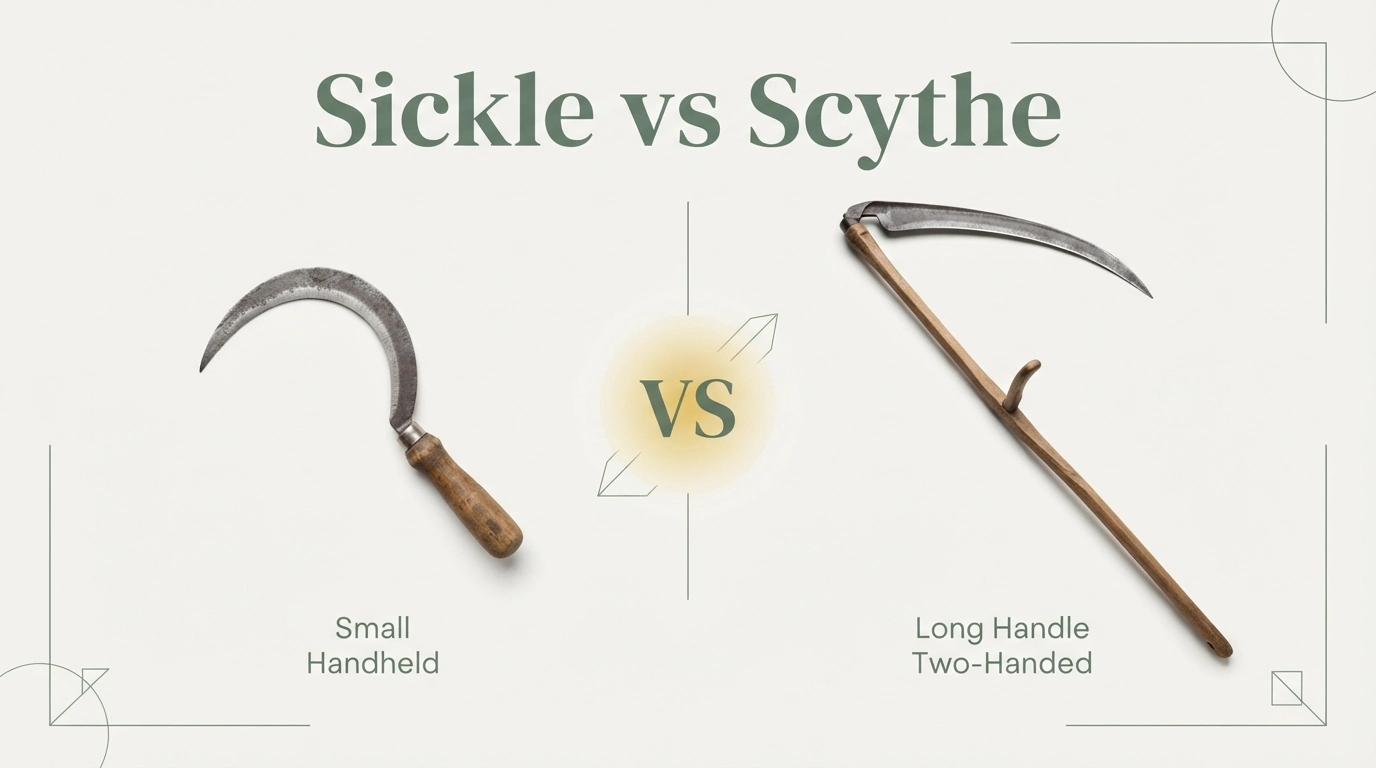
A sickle is a small hand tool with a short, curved blade. You use it with one hand for close, careful cutting. A scythe has a long pole and a long blade. You swing it with both hands to cut wide strips of grass or grain. Sickle vs scythe comes down to size and reach.
Key Takeaways
- Size: a sickle fits in one hand, while a scythe has a pole about 5½ feet long.
- Use: a sickle takes one hand and a bent back. A scythe takes two hands and an upright stance.
- Best jobs: sickles suit weeding and small patches. Scythes suit meadows and tall grass.
- Symbols: the scythe belongs to the Grim Reaper. The sickle belongs to the hammer and sickle.
🔍 Sickle vs Scythe at a Glance
Both tools have a curved blade, and both cut plants. This table shows where they split.
| Feature | Sickle | Scythe |
|---|---|---|
| Handle | Short grip | Long pole (snath) with side handles |
| Blade | Short, hooked curve | Long, slightly curved, set at an angle |
| Grip | One hand | Both hands |
| Posture | Stooping or kneeling | Standing upright |
| Cut per stroke | A small bunch of stalks | A wide strip of grass or grain |
| Best for | Weeding, trimming, small patches | Meadows, tall grass, large areas |
| Symbol | Hammer and sickle | Grim Reaper |
🌾 What Is a Sickle?
A sickle is a hand tool with a curved blade. It is one of the oldest farm tools in history.
🔪 Design and Blade Shape
The blade curls into a hook or half circle. The sharp edge runs along the inside of the curve.
Some blades have a smooth edge. Others have small teeth, called serrations.
✋ How People Use It
One hand grabs a bunch of stalks. The other hand pulls the blade through them.
You usually stoop or kneel, so a sickle suits short jobs.
🏺 A Short History
People have used sickles since the Stone Age, mainly to harvest grain.
The scythe came much later.
🌿 What Is a Scythe?
A scythe is a tall hand tool made for mowing grass and reaping grain. Its long handle lets you cut a lot of ground without bending over.
🧩 Main Parts
People call the long pole the snath. It often runs about 5½ feet.
The steel blade sits at the bottom end, set at an angle to the pole. Most blades run 2 to 3 feet long.
Most snaths have one or two small side handles. You can usually adjust them to fit your body.
🌬️ How the Swing Works
You stand tall and swing the blade low across the ground in a wide arc.
The long handle gives you leverage, so each stroke cuts a wide strip.
A sharp blade matters. A dull one tugs at the grass and wears you out fast.
⚔️ Key Differences Between a Sickle and a Scythe
The table gave the quick view. Here is why each difference matters.
📏 Size and Handle Length
A sickle gives you control because it stays close to your hand. A scythe gives you reach because its pole is long.
🌙 Blade Shape and Angle
A sickle blade hooks around the plants and cuts near your hand. A scythe blade runs long and sits at an angle, so it slices low along the ground.
🧍 Grip and Body Position
On a sickle, one hand cuts and the other holds the plants. A scythe takes both hands and an upright stance.
Standing tall spares your back on long jobs.
⏱️ Speed and Area Covered
One scythe stroke cuts a wide strip. A sickle cuts only what fits in your grip.
That reach let one farmer handle far more land. Horse-drawn machines and tractors later replaced the scythe on large farms.
🛠️ Which One Should You Use Today?
Tractors and mowers took over large farms. Still, some people use hand tools for small, quiet, fuel-free jobs.
In the scythe vs sickle choice, the size of the job decides.
🌱 Best Jobs for a Sickle
Pick a sickle when the job is small or the space is tight.
- Weeding garden beds
- Trimming grass along fences, walls, and posts
- Cutting a few tall weeds
- Harvesting a small patch of grain or herbs
🌾 Best Jobs for a Scythe
Pick a scythe when the ground is open and the grass is tall.
- Clearing a meadow or an overgrown lawn
- Mowing hay
- Cutting a large patch without fuel or engine noise
A scythe needs room to swing and fairly smooth ground. Rocks and hidden objects can chip the blade.
It also takes practice, so start with short, slow strokes.
🦺 Basic Safety Tips
- Wear sturdy shoes and long pants.
- Put a cut-resistant glove on the hand that holds the plants.
- Check the ground for rocks, wire, and hidden objects before you start.
- Keep people and pets well outside your swing.
- Cover the blade when you carry or store the tool.
- Sharpen the blade as it dulls, since dull edges slip.
💀 Symbolism: Grim Reaper and Hammer and Sickle
Each tool also became a famous symbol. People swap them often, so it helps to know which is which.
☠️ Why Death Holds a Scythe
Artists show the Grim Reaper with a scythe. The image compares death to a harvest, where the reaper cuts down lives like a crop.
☭ Why the Sickle Sits on the Soviet Flag
The flag of the former Soviet Union showed a hammer and a sickle. The hammer stood for factory workers, and the sickle stood for farmers.
🔀 Why People Mix Them Up
The two tools grew up side by side, so their shapes often overlap.
🧬 In-Between Tools
Some sickles had longer handles and blades. Some scythes were lighter and more curved to suit grain.
That left many tools that are hard to label.
🩸 The Sickle Cell Name Link
You may also see this word in sickle cell disease. The name comes from the curved shape of the affected red blood cells.
❓ FAQ
Is a scythe bigger than a sickle?
Yes. A scythe has a pole about 5½ feet long and a blade that often runs 2 to 3 feet. A sickle fits in one hand. That size gives the scythe much more reach.
Which is older, the sickle or the scythe?
The sickle is older. People used sickles in the Stone Age to harvest grain. The scythe came later and made mowing much faster.
Can you use a sickle to cut grass?
Yes, for small areas. A sickle handles grass along fences, walls, and garden beds well. For a whole lawn or field, it is slow and hard on your back, so a scythe fits better.
Which tool does the Grim Reaper carry?
The Grim Reaper carries a scythe. Many people say sickle by mistake. The sickle belongs to the hammer and sickle symbol.
Are sickles and scythes still used today?
Yes, but far less than before. Tractors and mowers replaced them on big farms. Some gardeners and small-scale farmers still use them for small, quiet, no-fuel jobs.
✅ Conclusion
Sickle vs scythe is an easy call once you know the job. A sickle gives you control in tight spaces, and a scythe gives you speed in open ground.
Small and close means sickle. Big and open means scythe.
Want the full story behind these tools? Read the history of the scythe.

I am a professional content writer focused on delivering value through words.
I craft informative and engaging articles across diverse topics.
I actively write for dreamunionz.com to share knowledge and creativity.