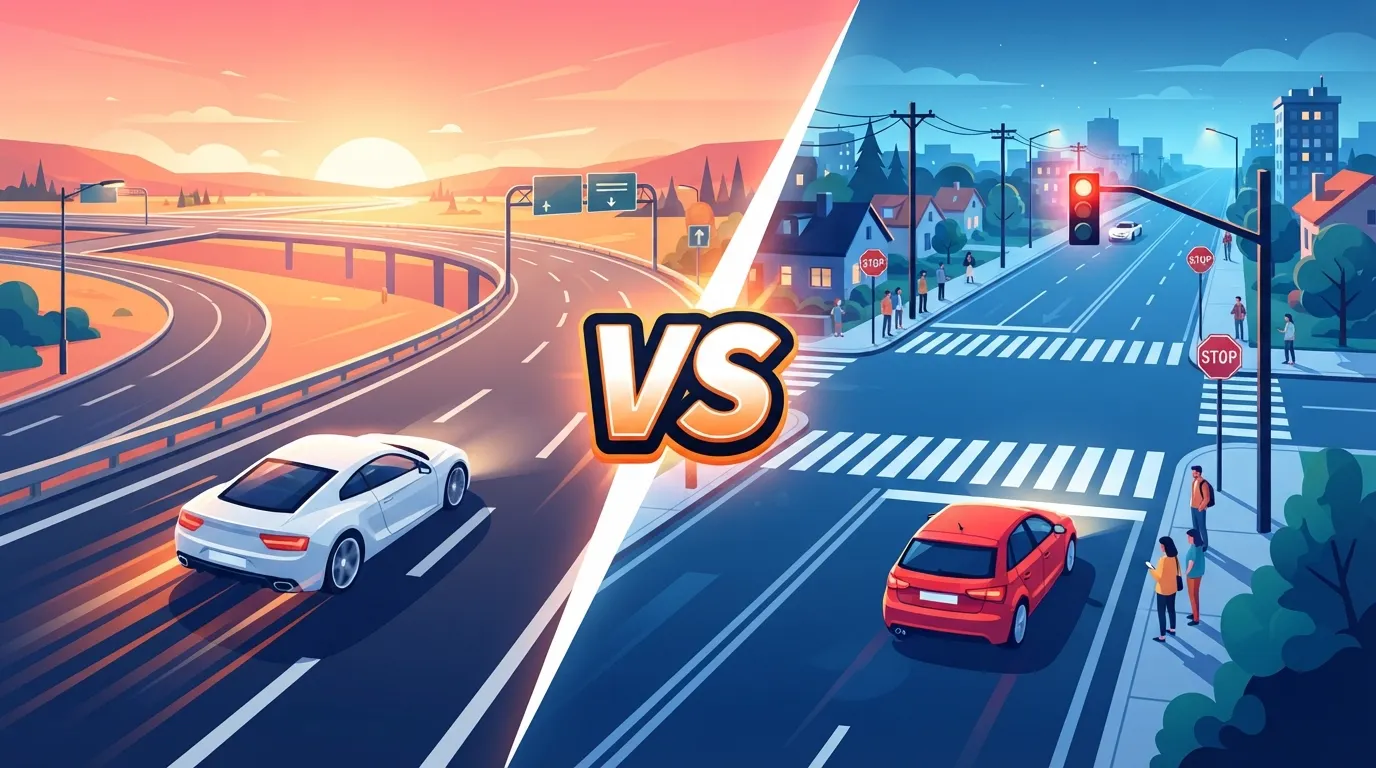
A highway is any major public road built for travel between places, often including intersections and traffic lights. A freeway is a specific type of highway with controlled access, meaning vehicles only enter or exit using ramps, with no stop signs or lights.
Core Difference: Every freeway is a highway, but not every highway is a freeway.
🔑 Key Takeaways
🔹A freeway is just a special type of highway.
🔹Freeways never have stop lights. Highways sometimes do.
🔹Freeways usually allow higher speeds.
🔹”Expressway” and “motorway” mean almost the same thing as freeway.
🔹Highways have more crashes overall. Freeway crashes tend to be worse.
🔹Real road examples make this super easy to picture.
Each line is now short enough to read in one glance on a phone screen, with simpler wording and no compound sentences.
🟣🟣🟣🟣🟣🟣🟣🟣
🛣️ What Is a Highway?
A highway is a broad term. It covers almost any major road built to connect towns, cities, or states.
Highways can have stop lights. They can have driveways and side streets feeding directly into them.
Some are simple two-lane roads. Others stretch to four or more lanes.
✔ Speed limits on highways usually sit between 45 and 65 mph, depending on the area and how built-up it is.
💡 Here’s the part that trips people up: a highway doesn’t need ramps, medians, or any special design.
It just needs to be a major public road meant for regional travel.
That flexible definition is exactly why the word gets used so loosely in everyday conversation.
🟣🟣🟣🟣🟣🟣🟣🟣
🚗 What Is a Freeway?
A freeway is a highway with one key upgrade: controlled access.
That means drivers can only get on or off using ramps. There are no traffic lights. No stop signs. No cars pulling out of a driveway in front of you.
✔ This design keeps traffic moving at a steady, higher speed. Most freeway speed limits run from 65 to 80 mph.
Freeways also look different from the driver’s seat. Curves are wide and gentle. Elevation changes happen gradually.
Engineers design them this way on purpose, so drivers never need to slam the brakes for a sharp turn.
💡 Here’s the easiest way to remember the whole concept: all freeways are highways, but not all highways are freeways.
🟣🟣🟣🟣🟣🟣🟣🟣
📊 Highway vs Freeway: Side-by-Side Comparison
| Feature | Highway | Freeway |
| Access | Ramps, driveways, side streets | Ramps only |
| Traffic signals | Yes, possible | Never |
| Cross-traffic | Yes, possible | None |
| Typical speed limit | 45–65 mph | 65–80 mph |
| Curves and grades | Can be sharp or steep | Wide, gradual |
| Best for | Local and regional travel | Long-distance, high-speed travel |
🟣🟣🟣🟣🟣🟣🟣🟣
📜 A Quick History
§ The US didn’t always have freeways. Early highways connected cities, but they ran straight through town centers, past homes, and across intersections.
→ That changed in the 1950s. President Eisenhower pushed for a national system of controlled-access roads after seeing Germany’s autobahn network during World War II. The result was the Interstate Highway System, signed into law in 1956.
★ That single decision is why almost every interstate in America today counts as a freeway. The system was built specifically to move people and freight quickly, without the slowdowns that regular highways create.
🟣🟣🟣🟣🟣🟣🟣🟣
🌍 What Other Countries Call It
The US isn’t the only place with this naming mix-up. Other countries use different words for the same basic idea.
⟢ UK, Ireland, India: motorway
⟢ Germany: autobahn
⟢ Italy: autostrada
⟢ Australia: freeway or motorway, depending on the state
⟢ Many US states: expressway, though a few keep occasional intersections
The core idea stays the same everywhere. Controlled access equals faster, safer, uninterrupted driving.
🟣🟣🟣🟣🟣🟣🟣🟣
🚧 Real Roads You Already Know
Examples make this click faster than any definition ever could.
📌 Freeway examples:
Interstate 95 (I-95) on the East Coast. Interstate 10 (I-10) across the South. Both have ramps only, no stop lights, ever.
📌 Highway (non-freeway) examples:
US Route 1 as it passes through small towns. State Route 27 in Florida. These roads mix through-traffic with local stop lights and driveways.
📌 Rule of thumb:
if a road number starts with “I-” (Interstate), it’s almost always a freeway. If it starts with “US” or a state route number and runs through town centers, it’s likely a regular highway.
🟣🟣🟣🟣🟣🟣🟣🟣
🚨 Safety: Which One Is Actually Riskier?
This is a question a lot of guides skip, and it deserves a real answer.
Highways see more total crashes. That’s because intersections, driveways, and cross-traffic create more chances for two vehicles to collide at the wrong moment.
Freeways see fewer crashes overall, but the ones that happen tend to be more severe. Higher speeds mean less time to react and more force on impact.
Neither one is simply “the safe choice.” Highways trade speed for more potential conflict points. Freeways trade fewer conflict points for higher-speed risk. Good driving habits matter more than which road type you’re on.
🟣🟣🟣🟣🟣🟣🟣🟣
🧭 Driving Tips for Each
On a highway:
- Watch for cars pulling out of driveways or side streets
- Slow down earlier for intersections and stop lights
- Stay alert near pedestrian crossings in town areas
On a freeway:
- Match traffic speed before merging, not after
- Keep extra following distance at higher speeds
- Never brake suddenly. There’s no one behind you expecting it
🟣🟣🟣🟣🟣🟣🟣🟣
❌ 5 Myths People Get Wrong
Myth 1: Freeways always have more lanes.
Not true. A rural freeway can have just one lane each direction. Lane count doesn’t define the category — access control does.
Myth 2: Highways are always slower.
Not always. A well-designed highway with light traffic can move nearly as fast as a freeway over a short stretch.
Myth 3: “Freeway” means it’s free of tolls.
Nope. “Free” refers to free-flowing traffic, not price. Plenty of freeways charge tolls.
Myth 4: Every interstate is a freeway.
Almost every one is, but a small handful of older interstate segments still have at-grade intersections in rural stretches, which technically breaks the freeway definition.
Myth 5: Highways are only found in rural areas.
False. Highways run through cities, suburbs, and small towns alike. Location doesn’t decide the category. Access control does.
🟣🟣🟣🟣🟣🟣🟣🟣
❓ Quick Answers
Is a freeway the same as a highway?
▶ Not exactly. A freeway is one type of highway — the type with fully controlled access and no traffic signals. All freeways are highways, but not all highways are freeways.
What’s the difference between a highway and an interstate?
▶ An interstate is a specific freeway network built and maintained under federal standards. Nearly every interstate qualifies as a freeway.
Why is it called a “freeway”?
▶ The name points to free-flowing traffic — no stops, no lights — not to being toll-free.
Is a motorway the same as a freeway?
▶ Yes, essentially. “Motorway” is the term used in the UK, Ireland, and several other countries for what Americans call a freeway.
Do freeways ever have stop lights?
▶ No. That’s the one rule that never bends. The moment a road has a traffic light or stop sign, it’s not a freeway anymore.
Is an expressway the same as a freeway?
▶ Usually, yes. Most US states use “expressway” and “freeway” interchangeably. A few states use “expressway” for roads with occasional intersections, so it can be a partial exception.
Why do some highways feel faster than freeways?
▶ Light traffic and long straight stretches can make a highway feel quick, even though its official speed limit sits lower than a freeway’s.
🟣🟣🟣🟣🟣🟣🟣🟣
✅ Bottom Line
Every freeway is a highway. Not every highway is a freeway.
The one thing that decides it: access control. No ramps-only entry and exit means no freeway, no matter how wide or fast the road feels.
Next time you’re driving, check for on-ramps and off-ramps. That’s your answer.

I am a creative mind driven by research and innovation.
I develop compelling content that informs and inspires audiences.
I publish my work on dreamunionz.com where ideas come to life.