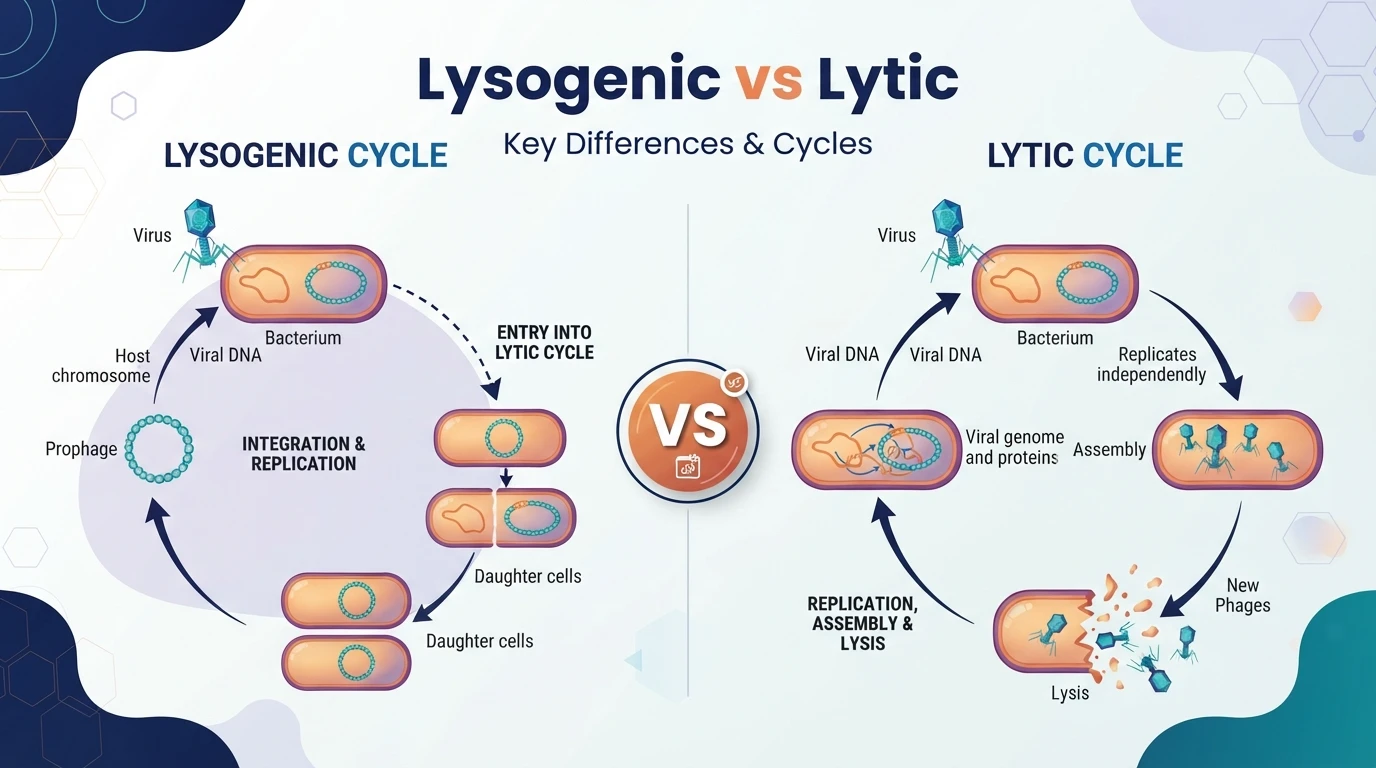
The lytic cycle makes a virus copy itself right away and burst the host cell open. The lysogenic cycle hides the viral DNA inside the host’s DNA, where it stays dormant and copies along with the cell. Lysogenic vs lytic comes down to timing: attack now, or wait and spread quietly.
Key Takeaways
- Lytic: fast. The virus makes new viruses and kills the host cell.
- Lysogenic: slow. The viral DNA joins the host’s DNA and waits.
- The switch: stress can wake a hidden virus and push it into the lytic cycle.
- Phage types: virulent phages only go lytic. Temperate phages can do both.
- Why it matters: phage therapy favors lytic phages, and lysogenic phages can add toxin genes to bacteria.
🔍 Lysogenic vs Lytic Cycle at a Glance
Both cycles start the same way. The virus attaches to a cell and injects its genetic material.
The big split comes after entry: attack now, or hide first.
| Feature | Lytic Cycle | Lysogenic Cycle |
|---|---|---|
| Speed | Fast. New viruses form right away. | Slow. The virus waits. |
| Viral DNA | Stays separate inside the cell | Usually joins the host DNA as a prophage |
| Host DNA | Broken down | Left intact |
| Host cell | Bursts and dies | Stays alive and keeps dividing |
| New viruses | Made at once | Made only after a switch to the lytic cycle |
| How it spreads | Through released viruses | Through cell division |
| Phages that use it | Virulent and temperate phages | Temperate phages only |
| Classic example | T4 phage | Lambda phage |
| Nickname | The active cycle | The dormant cycle |
💥 What Is the Lytic Cycle?
In the lytic cycle, a virus takes over a cell and uses it as a copy machine. At the end, the cell breaks open, which scientists call lysis.
T4, a virus that infects E. coli bacteria, is a classic example.
Virulent phages like T4 use this cycle every time.
🪜 The Lytic Cycle Steps
- Attachment: the virus sticks to the outside of the host cell.
- Entry: the virus injects its genetic material, and the empty shell stays outside.
- Takeover: early viral proteins break down the host DNA, and the virus controls the cell’s machinery.
- Assembly: the cell builds many new viruses.
- Lysis: the cell bursts and releases the new viruses, which go on to infect other cells.
🤫 What Is the Lysogenic Cycle?
In the lysogenic cycle, the virus hides instead of attacking. Its DNA joins the host’s DNA, and the host cell stays alive.
The hidden viral DNA is a prophage. The cell copies it every time it divides.
Scientists call a cell that carries a prophage a lysogen. It can carry the prophage for many generations.
A prophage can also shield its host from attack by related phages.
Lambda phage, which also infects E. coli, is the textbook example.
🪜 The Lysogenic Cycle Steps
- Attachment and entry: these steps match the lytic cycle.
- Integration: the viral DNA inserts itself into the host’s chromosome.
- Dormancy: the prophage stays quiet and does not make new viruses.
- Copying: each time the host divides, both daughter cells inherit the prophage.
⚡ What Makes a Hidden Virus Switch to the Lytic Cycle?
A prophage can wake up at any time. Scientists call this switch induction.
Stress often triggers it. Starvation, toxins, and DNA damage from UV light are common examples.
The prophage then cuts itself out of the host DNA and starts the lytic cycle.
The new viruses can infect fresh cells and go lysogenic there, so the pattern can repeat.
Conditions matter from the start, too. The health of the host cell can influence which path a temperate phage takes.
🧫 A Lambda Phage Example
Lambda phage shows the switch clearly.
In a healthy E. coli cell, a repressor protein keeps the prophage quiet.
When the cell suffers DNA damage, alarm signals break down that repressor.
The prophage then leaves the chromosome and starts making new viruses.
🧬 Virulent vs Temperate Phages
Not every phage gets a choice. Virulent phages use only the lytic cycle.
Temperate phages can use either one. Lambda phage is a temperate phage.
Some sources call them lytic phages and lysogenic phages instead.
🔬 How Scientists Test for Each Cycle
Lytic phages leave clear spots, called plaques, on a lawn of bacteria. Each spot shows where the phages killed the cells.
Hidden prophages take a different test. Scientists add a DNA-damaging chemical such as mitomycin C to wake them up.
If the cells burst and release phages, the prophage was there all along.
🎲 Why Do Viruses Have Two Strategies?
Each strategy pays off in different conditions. Researchers describe the switch as a trade-off between the two.
Attacking gives a quick burst of new viruses. Hiding keeps the virus safe inside a living, dividing host.
That is why many temperate phages keep both options.
🌍 Why the Difference Matters
💊 Phage Therapy
Phage therapy uses viruses to kill harmful bacteria. Researchers favor strictly lytic phages because they destroy the target cells.
Temperate phages make a poor fit. They can pass toxin or resistance genes between bacteria.
That is why the lytic or lysogenic label guides which phages scientists choose.
☣️ Lysogenic Conversion
A prophage can give its host new traits. People call this lysogenic conversion.
The bacterium that causes diphtheria makes its toxin because a phage carries the toxin gene.
Some Shiga toxin–producing E. coli strains work the same way.
⚠️ Common Mix-Ups
- Lysogenic does not mean harmless. The hidden virus can wake up later, and it can add toxin genes.
- A prophage is not a virus particle. It is viral DNA sitting inside the host DNA.
- Temperate phages can still go lytic. The lysogenic state does not last forever.
- Lytic does not mean stronger. Both cycles work well for the virus, just under different conditions.
- The terms fit phages best. Viruses of animals and plants can also stay latent or kill the cell, but scientists often say “latent” for those.
🧠 A Simple Way to Remember
Lytic sounds like lysis. The cell bursts.
Lysogenic sounds like lies low. The virus hides and waits.
❓ FAQ
Which cycle kills the host cell?
The lytic cycle does, because the new viruses burst the cell open. In the lysogenic cycle, the host survives until the prophage switches to the lytic cycle.
Can one virus use both cycles?
Yes, if it is a temperate phage. It can hide as a prophage first and turn lytic later, while virulent phages only use the lytic cycle.
Is T4 lytic or lysogenic?
T4 is strictly lytic. It always destroys its E. coli host.
Is the lysogenic state permanent?
No. A prophage can stay put for many generations, but it can switch to the lytic cycle at any time.
What is a prophage?
A prophage is phage DNA that has joined a bacterial chromosome. It stays dormant and copies along with the host each time the cell divides.
What triggers the switch to the lytic cycle?
Stress triggers it, and starvation, toxins, and DNA damage are common causes. Scientists call the switch induction.
Do human viruses use these cycles?
The terms come from phage research. Some human viruses, such as herpes viruses, also go dormant and wake up later, but scientists call that latency.
✅ Conclusion
Both cycles help a virus spread, but they run on different clocks. The lytic cycle is quick and ends with a burst cell, while the lysogenic cycle is slow and keeps the host alive.
Temperate phages can do both, so the same virus can attack now or wait.
Want a deeper look at the science? Read the full lysogenic cycle overview.

I am a detail-oriented writer passionate about digital content creation.
I focus on producing clear, engaging, and reader-friendly articles.
I proudly contribute to dreamunionz.com as a committed content author.