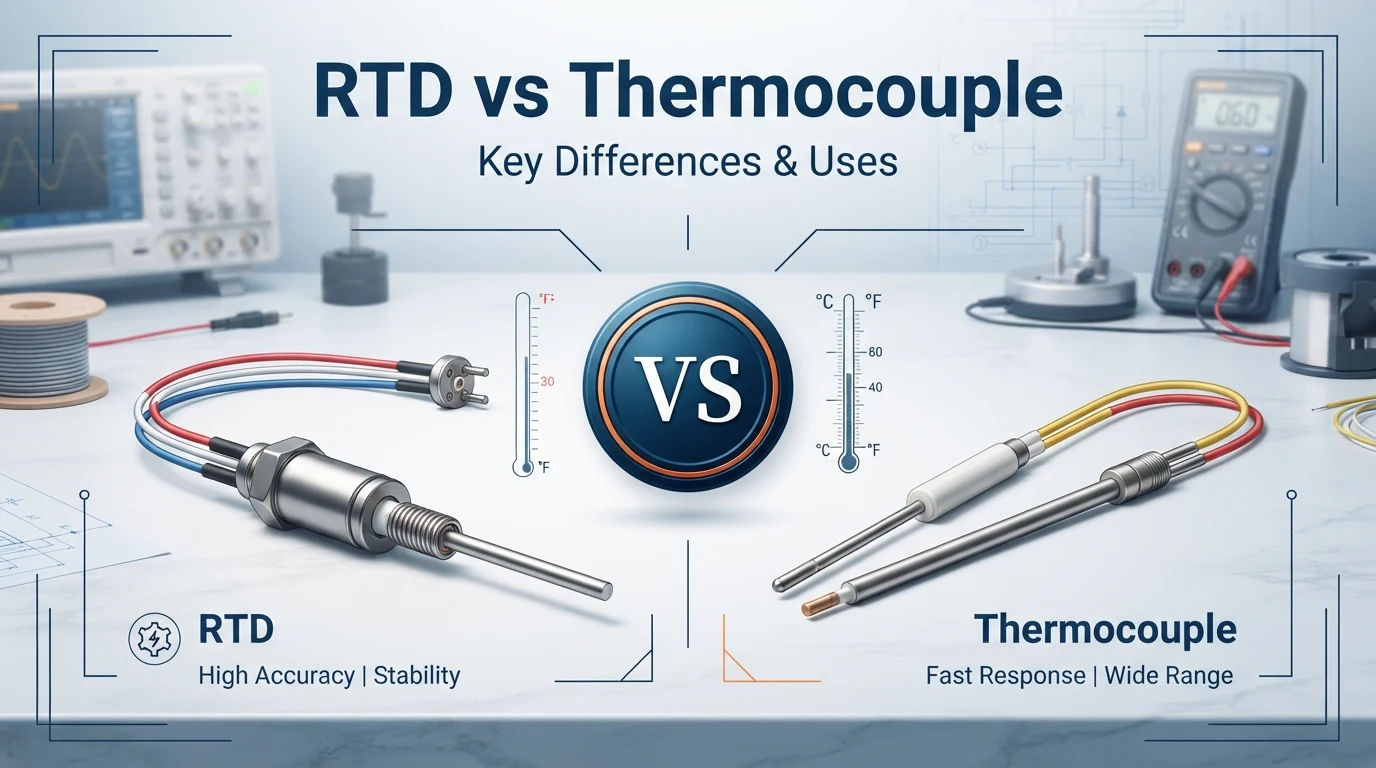
An RTD (resistance temperature detector) measures temperature by tracking how a metal’s electrical resistance changes. A thermocouple measures it with the tiny voltage that two different metals make when heated. RTD vs thermocouple comes down to this: RTDs give better accuracy and stability, while thermocouples handle higher heat, react faster, and cost less.
Key Takeaways
- Accuracy: RTDs win. A Class A Pt100 reads within ±0.15°C at 0°C, while a standard Type K thermocouple allows ±2.2°C.
- Range: thermocouples win. Type K works up to 2,502°F (1,372°C), while a Pt100 tops out near 1,112°F (600°C).
- Speed and toughness: thermocouples respond faster and handle vibration better.
- Cost: an RTD often costs two to three times more than a similar thermocouple.
- Rule of thumb: pick an RTD for precise, steady readings in moderate heat. Pick a thermocouple for extreme heat, fast response, or rough conditions.
🔍 RTD vs Thermocouple at a Glance
A check mark shows the stronger sensor for each factor.
| Factor | RTD (Pt100) | Thermocouple (Type K) |
|---|---|---|
| Accuracy | ✅ About ±0.15°C (±0.27°F) for Class A at 0°C | ±2.2°C (about ±4°F) or 0.75% of the reading |
| Stability | ✅ Holds its calibration for years | Drifts as the metals age |
| Temperature range | −328°F to 1,112°F (−200°C to 600°C) | ✅ −454°F to 2,502°F (−270°C to 1,372°C) |
| Response time | Slower | ✅ Faster, especially with a grounded junction |
| Vibration | More delicate | ✅ Tougher |
| Cost | Often 2 to 3 times higher | ✅ Lower |
| Output | ✅ Close to linear | Nonlinear, but standardized |
| Power | Needs a small current from the instrument | ✅ Makes its own voltage |
⚙️ How Each Sensor Works
The two sensors use different physics. That one fact drives every other difference.
🌡️ What Is an RTD?
An RTD uses a metal whose resistance rises as it heats up. Most RTDs use platinum.
The most common type is the Pt100. The “Pt” stands for platinum, and “100” means 100 ohms (a unit of electrical resistance) at 32°F (0°C).
RTDs come with 2, 3, or 4 wires. Extra wires cancel out the error that lead wires add.
⚡ What Is a Thermocouple?
A thermocouple joins two different metals at one end. When that end heats up, the pair makes a small voltage, which people call the Seebeck effect.
The voltage depends on the temperature gap between the hot end and the cold end. Because the sensor makes its own voltage, it needs no power.
The metals set the type. Type K uses chromel and alumel, Type J uses iron and constantan, and Type T uses copper and constantan.
🎯 Accuracy and Stability: RTDs Win
RTDs read closer to the true temperature. A Class A Pt100 holds about ±0.15°C (±0.27°F) at 0°C.
A standard Type K thermocouple allows ±2.2°C (about ±4°F) or 0.75% of the reading, whichever is greater.
Drift matters too. Drift means a sensor slowly reads off as it ages.
Heat changes the metal wires over time. Oxidation and contamination shift the voltage they make, so the reading slowly moves.
One industry guide reports that Type K can drift 1 to 2°C per year in hot air that oxidizes (rusts) the wires. The same guide says a Class A Pt100 drifts less than 0.1°C (0.2°F) per year under stable conditions.
Good thermocouples with careful calibration can close part of the gap. Even so, RTDs stay the safer pick when precision matters.
🔥 Temperature Range: Thermocouples Win
Thermocouples handle far more heat. Type K works from −454°F to 2,502°F (−270°C to 1,372°C).
Special thermocouple types reach about 4,200°F (2,300°C).
A Pt100 runs from about −328°F to 1,112°F (−200°C to 600°C). Some designs reach 1,562°F (850°C), but sources differ on the exact limit.
Above that limit, choose a thermocouple.
⏱️ Response Time, Size, and Vibration
Thermocouples react faster. A grounded junction, where the wire tip touches the probe tip, can respond nearly three times faster than a standard Pt100.
Thinner RTD probes have narrowed the gap, but thermocouples still lead.
Thermocouples also fit into smaller spaces.
Vibration is another strength. RTD elements are more delicate, so heavy shaking can damage them.
💰 Cost and Wiring
An RTD often costs two to three times more than a thermocouple of the same build. Wiring adds a few more differences.
Think about total cost too. An RTD’s higher price buys stability, so you may recalibrate less often.
🔌 RTD Wiring
An RTD needs a small current from your instrument. That current can warm the sensor a little, which people call self-heating.
Good instruments keep that current small, so the effect stays minor.
Use a 3-wire or 4-wire RTD on long cable runs to cancel lead wire error.
🔗 Thermocouple Wiring
A thermocouple needs matching thermocouple wire all the way to the instrument. Normal copper wire adds errors.
The instrument also measures the temperature at the wire ends. People call this step cold junction compensation.
🧭 How to Choose Between an RTD and a Thermocouple
Ask these four questions in order.
- How hot does it get? Above about 1,100°F (600°C), pick a thermocouple.
- How precise must the reading be? If you need tenths of a degree, pick an RTD.
- How fast does the temperature swing? For quick changes, pick a thermocouple.
- How rough is the setting? Shaking, high pressure, and harsh conditions favor a thermocouple.
Pick an RTD for:
- Lab and pharmaceutical work
- HVAC systems
- Steady processes that need tight control
- Long-term stability with little recalibration
Pick a thermocouple for:
- Hot equipment such as furnaces and kilns
- Fast-changing temperatures
- Tight spaces
- Shaky or rough equipment
🧪 Three Quick Examples
A lab incubator holds 98.6°F (37°C) and needs tight accuracy in mild heat. An RTD fits best.
A kiln runs near 2,000°F (1,093°C). That sits far above the RTD limit, so only a thermocouple works.
A test rig shakes hard while it heats up fast. A thermocouple reacts quickly and handles the vibration.
⚠️ Common Mistakes
- Running an RTD past its limit. Heat above the rating can damage the element.
- Using a 2-wire RTD on a long cable. The wire adds resistance, so the reading runs high.
- Setting the wrong thermocouple type. A Type K probe on a Type J input gives a wrong reading.
- Skipping recalibration on old thermocouples. Drift builds up without warning.
- Choosing on price alone. A cheaper sensor that drifts can cost more in rework and bad readings.
❓ FAQ
Which is more accurate, an RTD or a thermocouple?
An RTD. Even a Class B Pt100, the looser grade, usually beats a thermocouple, and RTDs hold their calibration longer.
Which one handles higher temperatures?
A thermocouple. Some types reach about 4,200°F (2,300°C), far above the roughly 1,112°F (600°C) limit of a typical Pt100.
Does a thermocouple need power?
No. It makes its own small voltage, while an RTD needs a small current from the instrument.
Is an RTD the same as a thermistor?
No. A thermistor uses a semiconductor material, while an RTD uses a pure metal such as platinum.
Can I swap an RTD for a thermocouple?
Not directly, because each sensor sends a different signal. Your controller or meter must match the sensor type, so check its input settings first.
✅ Conclusion
RTD vs thermocouple is a trade between precision and toughness. An RTD gives you steady, accurate readings in moderate heat, and a thermocouple gives you range and speed.
Match the sensor to your hottest point, your accuracy need, and your setting. If you cannot decide, start with your highest temperature, because that one number settles many cases.
Want the science behind the voltage? Read the full thermocouple explainer.

I am a professional content writer focused on delivering value through words.
I craft informative and engaging articles across diverse topics.
I actively write for dreamunionz.com to share knowledge and creativity.