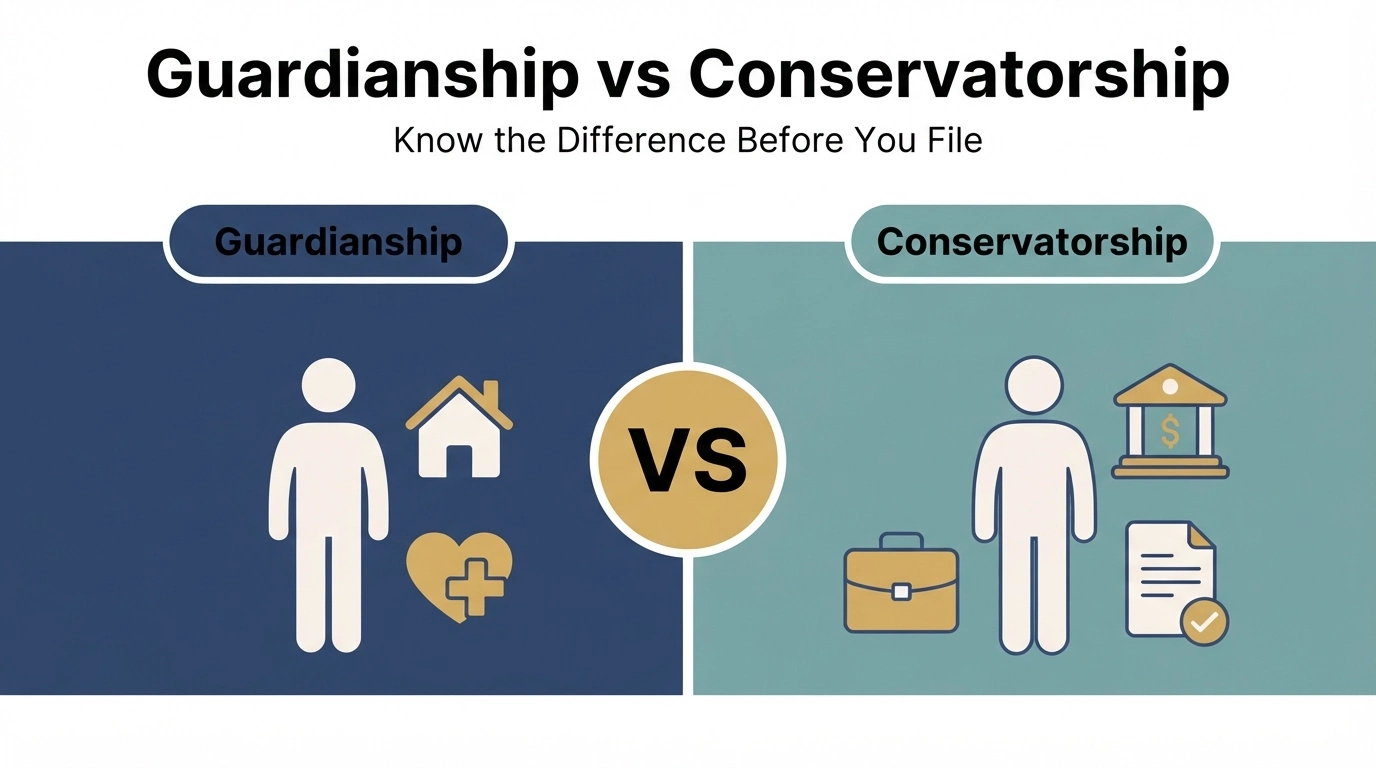
Guardianship gives someone legal authority over a person’s daily life and medical care, like where they live and what treatment they get. A conservatorship gives someone legal authority over a person’s money and property, such as bank accounts and bills.
A court appoints both roles for people who can’t manage their own affairs, but exact definitions shift from state to state.
Key Takeaways
◆ Guardianship usually covers personal and medical decisions; conservatorship usually covers money and property.
◆ State law determines what these words mean, so the same term can mean different things depending on where you live.
◆ A court must approve either arrangement, and it will only step in when there’s real proof the person can’t manage on their own.
◆ One person can often hold both roles at once if the situation calls for it.
◆ Less restrictive tools, like power of attorney, are worth ruling out first.
⬛⬛⬛⬛⬛⬛⬛⬛
🤔 Why These Two Words Get Mixed Up
Honest answer? There’s no single national definition.
Every state writes its own rules. So the same word can mean different things depending on where the case is filed.
Here’s how it plays out:
📍 California — “Guardianship” = minors only. “Conservatorship” = incapacitated adults.
📍 Tennessee — Also age-based, but the cutoff and labels work differently.
📍 Connecticut — Both words can apply to adults, depending on the type of care needed.
💡 Quick Tip
Before you hire an attorney, check your state’s probate court website — or just call the clerk’s office.
The core concepts below hold true almost everywhere. But the labels? Those can flip.
⬛⬛⬛⬛⬛⬛⬛⬛
What Is Guardianship?
Guardianship is a court order that gives one person legal authority to make personal decisions for someone who can’t make them safely on their own.
That includes:
⟢ Where the person lives
⟢ Medical treatment and healthcare choices
⟢ Daily care and supervision
⟢ Education decisions, if the ward is a minor
The person under guardianship is usually called a “ward.”
Guardianship most often applies to minors whose parents have died or can’t care for them, and to adults with a severe disability or cognitive decline.
Worth knowing: a guardian is a fiduciary. That means they’re legally required to act in the ward’s best interest, not their own.
A guardian isn’t automatically allowed to touch the ward’s bank account or property — that authority usually requires a separate conservatorship.
⬛⬛⬛⬛⬛⬛⬛⬛
What Is Conservatorship?
Conservatorship is a court order that gives one person legal authority to manage another person’s money and property. A conservator can typically:
➜ Pay bills and manage bank accounts.
➜ File taxes
➜ Handle investments
➜ Buy, sell, or manage real estate on the person’s behalf.
The person under conservatorship is usually called a “conservatee.” Conservatorship is almost always set up for adults, since minors rarely have complicated finances that need this level of oversight.
Like a guardian, a conservator is a fiduciary. Courts often require conservators to file regular financial reports so a judge can confirm the conservatee’s money is being handled properly.
⬛⬛⬛⬛⬛⬛⬛⬛
Guardianship vs Conservatorship at a Glance
| Covers | Personal care, healthcare, living situation | Money, property, financial decisions |
| Typical for | Minors, or adults with severe cognitive disability | Incapacitated adults |
| Person protected | “Ward” | “Conservatee” |
| Can I pay bills or manage accounts? | Not without added financial authority | Yes |
| Can I decide on medical treatment? | Yes | Not without added personal authority |
| Court oversight | Regular check-ins, sometimes annual reports | Regular financial reports required |
| Ends when | Ward turns 18, recovers capacity, or dies | Conservatee recovers capacity or dies |
⬛⬛⬛⬛⬛⬛⬛⬛
Who Actually Needs One of These
A few common situations bring families to this decision.
1. An aging parent with dementia
If a parent can no longer pay bills safely or make sound medical decisions, a court may need to appoint someone for one or both roles.
2. An adult child with a developmental disability
Parents sometimes petition for guardianship (and sometimes conservatorship) once the child turns 18 and legally becomes an adult in the eyes of the law.
3. A minor without a parent able to care for them
Guardianship lets a relative or family friend step in to raise the child and make everyday decisions.
4. Someone recovering from a sudden injury
A temporary guardianship or conservatorship can cover a short period, like recovery after a serious accident, without becoming a permanent arrangement.
⬛⬛⬛⬛⬛⬛⬛⬛
Can One Person Be Both Guardian and Conservator?
Yes — in most states, the same person can hold both titles.
This is common when one family member is the natural choice to handle everything: an adult child managing both mom’s finances and her medical care, for instance.
That said, some families split the roles instead:
➡️ One sibling handles the money as conservator
➡️ Another handles day-to-day care as guardian
Courts allow this when it fits the family’s situation better, though it can require more coordination between the two people.
⬛⬛⬛⬛⬛⬛⬛⬛
How to Get Guardianship or Conservatorship
The process is similar across most states, even though the paperwork names differ.
Step 1 — File a petition
With the probate court in the county where the person lives.
Step 2 — Notify close relatives
The person’s spouse, adult children, and sometimes siblings must be given formal notice.
Step 3 — Get a medical evaluation
A doctor or licensed evaluator confirms the person’s level of incapacity.
Step 4 — Attend a court hearing
A judge reviews the evidence and decides whether the arrangement is necessary and who’s suited to serve.
Step 5 — Receive letters of guardianship or conservatorship
This document proves the appointed person’s authority to banks, hospitals, and other institutions.
Cost and Timeline
| Timeline | Uncontested | Contested |
|---|---|---|
| Cost | $1,500–$5,000 | Often much more |
| Timeline | 6–12 weeks | Can stretch on for months |
✔ Filing fees, attorney costs, and required evaluations make up most of the cost. Contested cases — where a family disagrees about who should serve, or whether it’s needed at all — take longer and cost more.
⬛⬛⬛⬛⬛⬛⬛⬛
Alternatives Worth Considering First
Guardianship and conservatorship take away real legal rights, so courts prefer less restrictive options when they’ll work just as well.
◈ Power of attorney
Lets someone make financial or medical decisions on another person’s behalf, without a full court proceeding, as long as the person can still legally sign documents.
◈ Advance healthcare directive
Spells out medical wishes ahead of time so a court doesn’t need to decide later.
◈ Supported decision-making agreements
A newer option in many states, allowing someone with a disability to keep making their own decisions with structured help, instead of transferring authority entirely.
If any of these were set up before the person lost capacity, a full guardianship or conservatorship may not be necessary at all.
⬛⬛⬛⬛⬛⬛⬛⬛
How Guardianship and Conservatorship End
Guardianship over a minor typically ends automatically when the child turns 18.
Guardianship or conservatorship over an adult usually ends when one of these happens:
→ The person’s capacity is restored, and a court confirms it
→ The person passes away
→ A judge modifies or terminates the order after a review
⁍ Family members can petition the court to end or adjust the arrangement at any point if circumstances change.
⬛⬛⬛⬛⬛⬛⬛⬛
People Also Ask
Q1: What is the main difference between guardianship and conservatorship?
💡 Guardianship covers personal and medical decisions, while conservatorship covers money and property. Many states use both terms, but a few use only one to cover everything, so it’s worth checking local law.
Q2: Can the same person be both guardian and conservator?
💡 Yes. Courts commonly appoint one person to handle both roles when that person is capable of managing the ward’s personal care and finances together.
Q3: How do you get guardianship or conservatorship for someone?
💡 You file a petition with your local probate court, notify close relatives, provide a medical evaluation, and attend a hearing where a judge decides whether to grant the order.
Q4: Is guardianship or conservatorship better for an older parent?
💡 It depends on what they need help with. If they can still make medical decisions but can’t manage money safely, conservatorship alone may be enough. If both areas are affected, many families pursue both.
Q5: What’s a less restrictive alternative to guardianship?
💡 Power of attorney and advance healthcare directives are common alternatives, as long as they’re set up while the person still has legal capacity to sign them.
Q6: Does guardianship or conservatorship end automatically?
💡 Guardianship of a minor ends automatically at 18. For adults, either arrangement ends when the person’s capacity is restored, they pass away, or a judge terminates the order.
⬛⬛⬛⬛⬛⬛⬛⬛
🔑 Bottom Line:
Guardianship = personal & medical care.
Conservatorship = money & property.
Same goal. Different job.
But here’s the catch: the rules change depending on your state. Always double-check local terms before filing anything.
Before You File, Ask This:
Could power of attorney or an advance healthcare directive cover it instead?
If yes → skip the court process entirely.
If no → guardianship or conservatorship is your next step.
💬 Real Talk
This isn’t a DIY decision. A probate attorney in your state can confirm the right path, the paperwork, and the fastest way through — with the least stress for your family.

I am a dedicated writer who believes in the power of storytelling.
I create thoughtful content that connects with readers on a deeper level.
I contribute my creative work to dreamunionz.com with passion and originality.