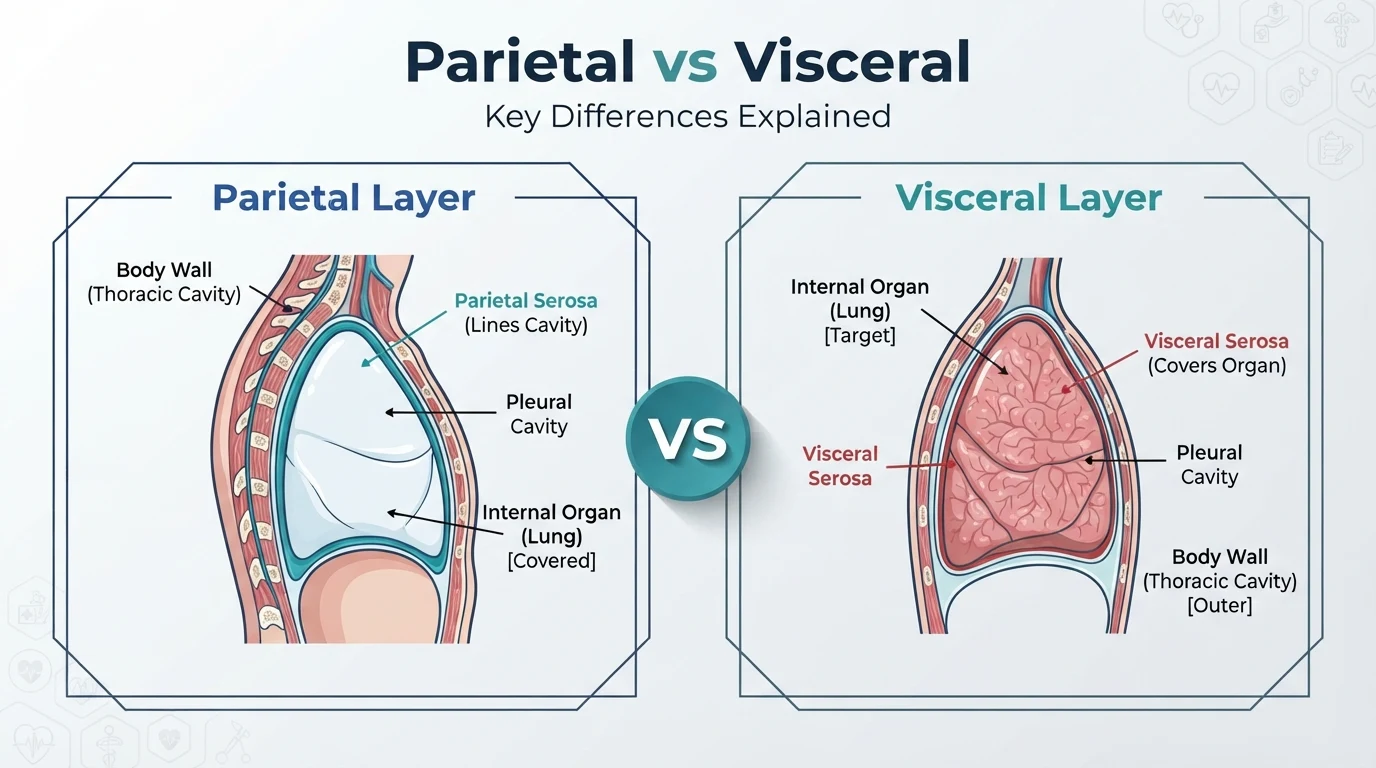
Parietal vs visceral is about position: the parietal layer lines the wall of a body cavity, while the visceral layer covers the organs inside it. You see this pairing in the pleura around the lungs, the pericardium around the heart, and the peritoneum in the abdomen. Parietal means wall, and visceral means organ.
Key Takeaways
- Parietal: the outer layer that lines the wall of a body cavity.
- Visceral: the inner layer that covers an organ.
- Where: the pleura, pericardium, and peritoneum each have both layers.
- Pain: parietal pain feels sharp and easy to locate. Visceral pain feels dull and hard to locate.
- Other uses: the words also name a skull bone, a brain lobe, stomach cells, and a type of belly fat.
🔍 Parietal vs Visceral at a Glance
Both words describe layers of the same membrane. Position is the main difference.
| Feature | Parietal | Visceral |
|---|---|---|
| Location | Lines the wall of the cavity | Covers the organ |
| Layer | Outer layer | Inner layer |
| Attachment | Sticks firmly to the body wall | Sticks tightly to the organ surface |
| Word root | Refers to a cavity wall | Comes from viscera, the internal organs |
| Nerve supply | Same nerves as the body wall | Automatic (autonomic) nerves |
| Pain | Sharp and well localized | Dull and poorly localized |
| Sensitive to | Pain, pressure, and temperature | Stretch and chemical irritation |
🧱 What Does Parietal Mean?
Parietal refers to the wall of a cavity. A cavity is a hollow space in the body, such as the chest or belly.
The parietal layer sits against that wall. It attaches firmly to the body wall from the inside.
The same root shows up in the parietal bone, which forms part of the skull wall.
🫀 What Does Visceral Mean?
Visceral comes from viscera, a word for the internal organs. The visceral layer wraps around an organ like a thin skin.
It sticks tightly to the organ surface, so you cannot peel it off easily.
On hollow organs like the stomach, this outer coat has its own name: the serosa.
🎈 How the Two Layers Work Together
Both layers belong to one membrane, called a serous membrane. It is a smooth, thin lining that makes a little fluid.
The two layers connect and form one continuous sheet.
In the abdomen, the folds where they meet form sheets that anatomists call mesenteries.
🥊 The Fist-and-Balloon Picture
Push your fist into a soft balloon. The layer touching your fist is the visceral layer.
The outer layer of the balloon is the parietal layer, and the gap between them is the cavity.
💧 The Thin Space Between
A very thin, fluid-filled space sits between the layers. Doctors call it a potential space, because it holds almost no room until fluid builds up.
📍 Where You Find Parietal and Visceral Layers
| Membrane | Surrounds | Parietal layer | Visceral layer |
|---|---|---|---|
| Pleura | Lungs | Lines the chest wall | Covers each lung |
| Pericardium | Heart | Forms a sac around the heart | Covers the heart (also called the epicardium) |
| Peritoneum | Abdominal organs | Lines the abdominal and pelvic wall | Covers most abdominal organs |
🫁 A Note on the Peritoneum
Organs like the stomach and liver sit fully inside the visceral peritoneum. The kidneys and pancreas sit behind it, so the parietal peritoneum covers only their front.
Doctors call the first group intraperitoneal and the second group retroperitoneal.
🩺 Parietal vs Visceral Pain
The two layers also explain two kinds of pain. Nerves make the difference.
The parietal layer uses the same nerves as the body wall, so its pain feels sharp and easy to point to. The visceral layer uses automatic nerves, so its pain feels dull and vague.
Each spot on the parietal layer sends its signal along a clear path. Your brain can pinpoint that spot.
Visceral pain can also show up in another part of the body, which doctors call referred pain.
Gallbladder trouble, for example, can cause pain in the right shoulder.
🔎 A Real-World Example
Early appendicitis often starts as a dull ache near the belly button. Later the pain moves to the lower right side and turns sharp.
The first pain is visceral. The second pain comes from irritation of the parietal peritoneum.
This section is for learning only. See a doctor for belly pain that gets worse or does not go away.
🏥 Why the Difference Matters in Medicine
Fluid can build up in the thin space between the layers. Doctors call this an effusion.
A pleural effusion collects around the lungs, and a pericardial effusion collects around the heart.
The parietal layer also matters in cancer research. Studies report that mesothelioma, a cancer linked to asbestos, usually starts in the parietal pleura.
Surgeons and nurses also need the two terms to describe exactly where a problem sits.
🧩 Other Meanings of Parietal and Visceral
These two words appear in other parts of biology, too.
- Parietal bone: one of two skull bones on the top and sides of the head.
- Parietal lobe: a brain region near the top and back of the head. It helps process touch and space.
- Parietal cells: stomach cells that make stomach acid.
- Visceral fat: fat stored deep in the belly around the organs.
- Visceral muscle: another name for smooth muscle in organ walls.
In everyday speech, “visceral” can also mean a deep gut reaction.
🧠 A Simple Way to Remember
Think P for perimeter. The parietal layer sits on the outer edge.
Think V for vital organs. The visceral layer hugs them.
On a test, ask one question: does the layer touch the wall or the organ?
⚠️ Common Mistakes
- Mixing up inner and outer. Parietal is the outer layer, and visceral is the inner layer.
- Treating them as two membranes. They are two layers of one membrane.
- Picturing a big gap. The space between them holds only a thin film of fluid.
- Forgetting the pain link. Doctors use the same two words to describe pain.
- Assuming every organ sits inside the cavity. Some, like the kidneys, sit behind the peritoneum.
❓ FAQ
Which layer sits closer to the organ?
The visceral layer. It rests directly on the organ, while the parietal layer rests against the body wall.
What sits between the parietal and visceral layers?
A thin film of serous fluid. It lets the layers slide past each other with little friction.
Why is visceral pain hard to locate?
Signals from organs travel through automatic nerves and overlap with signals from other body areas. The brain struggles to pinpoint the source.
Is the visceral pericardium the same as the epicardium?
Yes. The visceral pericardium is the layer that covers the heart, and many sources also call it the epicardium.
Is parietal pain the same as somatic pain?
In the abdomen, the terms overlap. Parietal pain comes from the lining of the body wall and travels on the same nerves as somatic pain.
Do the heart and lungs both have these layers?
Yes. The heart has a parietal and visceral pericardium, and the lungs have a parietal and visceral pleura.
✅ Conclusion
Parietal vs visceral is a question of position. The parietal layer faces the wall, and the visceral layer hugs the organ.
Together they form one smooth membrane that lets organs move without rubbing.
Learn the wall-versus-organ rule once, and most anatomy terms that use these words make sense.
Both words are adjectives, so each one describes a noun such as layer, pain, or fat.

I am a creative mind driven by research and innovation.
I develop compelling content that informs and inspires audiences.
I publish my work on dreamunionz.com where ideas come to life.